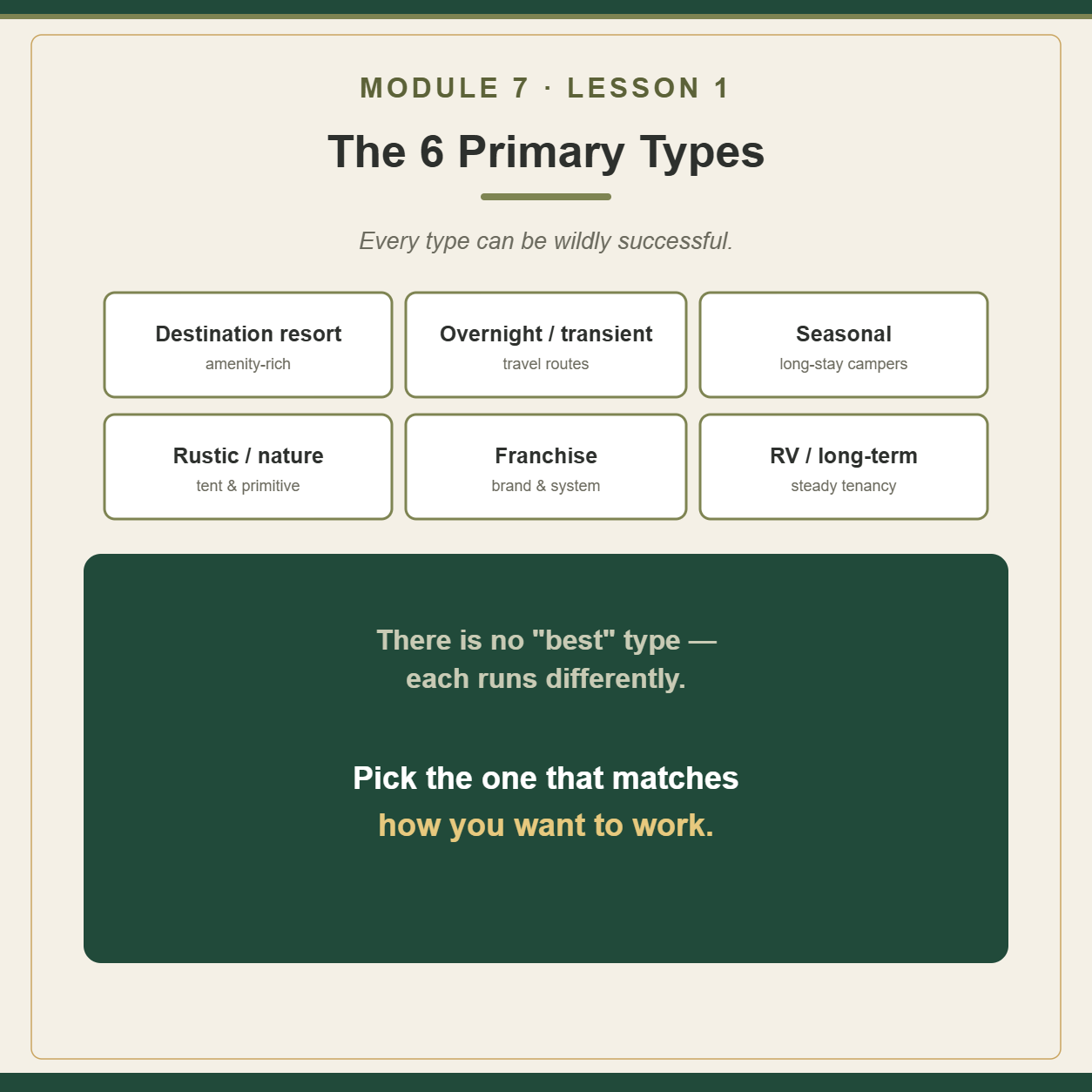
THERE IS NO “BEST” CAMPGROUND
Every one of these six types can be wildly successful. The key isn’t finding the “best” park — it’s finding the one that matches you: your budget, your management style, your experience, your family goals, your lifestyle, and your long-term vision. The wrong campground for one buyer is the perfect opportunity for another. As you read each type, watch the price range, the buyer type, and especially the things to consider — the day-to-day reality of owning that kind of park.
Here are the six primary types:
1. Destination / Resort Parks
High-end, amenity-rich, often near tourism hotspots.
FEATURES
- Pools, splash pads
- Cabins, park models
- Large RV sites
- High nightly rates
- Professional staff
- Large acreage
- Event spaces
- Store + activities
THINGS TO CONSIDER
- Higher payroll
- More employees
- Larger maintenance budgets
- Higher guest expectations
- More management systems
- Greater financial risk — but often greater rewards
Price Range: $3M–$20M+
Buyer Type: Experienced operators, investors, corporate, well-funded individuals.
2. Overnight / Transit Parks
Located on major highways or travel routes.
FEATURES
- Pull-through sites
- Simple amenities
- 1–3 night stays
- Easy operations
- Strong summer traffic
THINGS TO CONSIDER
- Heavy online booking
- Marketing matters
- Excellent signage is critical
- Guest reviews drive occupancy
- Consistent housekeeping
Price Range: $1.2M–$6M
Buyer Type: First-time owners, semi-retired couples, hands-on operators.
3. Seasonal Parks
The most predictable income.
FEATURES
- Guests pay for the season
- Low turnover
- Low labor
- Strong repeat guests
- Very stable NOI
THINGS TO CONSIDER
- Community management
- Seasonal contracts
- Rule enforcement
- Less daily turnover
- More relationship management
Price Range: $1M–$5M depending on number of seasonal sites
Buyer Type: First-time owners wanting stability, buyers who want minimal daily work, northern market buyers.
4. Destination Lake/Riverfront Parks
Very high demand, limited supply.
FEATURES
- Waterfront access
- Boat docks
- Premium rates
- Mixed lodging
- High value land
- Often older utilities
THINGS TO CONSIDER
- Flood risk
- Docks and shoreline permits
- Erosion
- Environmental regulations
- Higher insurance costs
Price Range: $2M–$15M+
Buyer Type: Buyers with capital, investors, people who want a lifestyle property with strong income potential.
5. Rustic / Low-Amenity / “Mom & Pop” Parks
Perfect for beginners with lower budgets.
FEATURES
- Basic RV sites
- Simple cabins
- Gravel roads
- Limited utilities
- Lower purchase price
THINGS TO CONSIDER
- Excellent value-add opportunity
- Often older infrastructure
- Deferred maintenance to budget for
- Room to raise rates
- Usually owner-operated
Price Range: $400k–$1.5M
Buyer Type: First-time buyers, small budgets, hands-on owners.
6. Mixed-Use Parks
Campground + motel, store, marina, restaurant, etc.
FEATURES
- Multiple revenue streams
- Multiple staff roles
- Higher complexity
- Great income potential
THINGS TO CONSIDER
- Multiple licenses
- More bookkeeping
- More employees
- Multiple profit centers
- Greater management complexity
Price Range: $1.5M–$10M+
Buyer Type: Experienced operators, buyers comfortable managing staff and multiple business types.
TWO MORE YOU SHOULD KNOW EXIST
Beyond the six, two categories are worth knowing even though most buyers won’t start there:
- Membership campgrounds — membership parks, camping clubs, and resort associations. They run on a completely different model (members, dues, and reservation rights instead of nightly rates). If one crosses your path, know it’s a different animal.
- Municipal & public campgrounds — state, county, city, Army Corps, and National Forest parks. They’re rarely for sale, but they set the competition and the price expectations in many markets, which helps explain why a nearby private park is priced the way it is.
WHICH CAMPGROUND FITS YOU?
Before the price tag, answer these honestly — they often decide the right type more than the purchase price does:
- Do I enjoy managing people?
- Do I enjoy hospitality?
- Am I handy with maintenance?
- Do I want predictable income, or growth opportunity?
- Do I want a lifestyle business, or an investment?
- Do I eventually want a business I can manage instead of operate?
COMPARE THEM AT A GLANCE
One table to size up all six at once:
| Type | Hands-On | Staffing | Capital | Complexity | Lifestyle |
|---|---|---|---|---|---|
| Resort | ★★★★★ | ★★★★★ | $$$$$ | High | Moderate |
| Overnight | ★★★ | ★★ | $$$ | Medium | Good |
| Seasonal | ★★ | ★ | $$ | Low | Excellent |
| Waterfront | ★★★ | ★★★ | $$$$ | Medium | Excellent |
| Mom & Pop | ★★★★ | ★ | $ | Low | Excellent |
| Mixed-Use | ★★★★★ | ★★★★★ | $$$$ | Very High | Moderate |
“Budget is the first filter, and it’s a ruthless one — before you fall for any of these six, your real number cuts the list to two or three. And I don’t just mean the sticker price. I mean what it costs to run it, to fix what’s tired, and to carry it through a slow season. The buyers who skip that math fall in love with a park they could buy but could never afford to own. Get your number honest, and the right type gets a whole lot clearer.”