YOU’RE BUYING A BUSINESS AND A LIFE
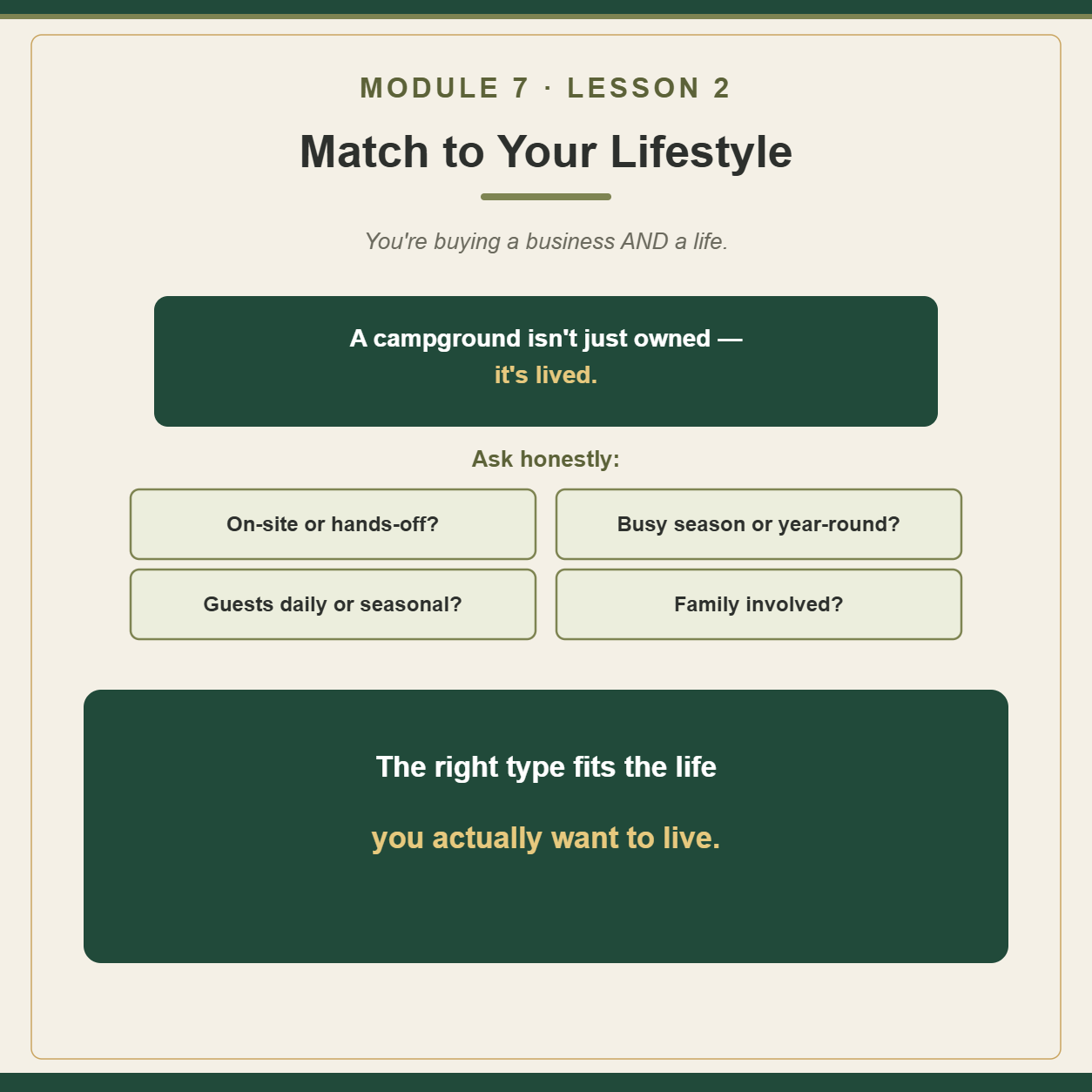
A campground is one of the few investments you don’t just own — you live it. It decides how you spend your mornings, your weekends, your summers, and who you spend them with. It is a business and a lifestyle at the same time, and the two have to match. When they don’t, owners burn out — no matter how good the spreadsheet looked. So before you match a park to your budget, match it to your days.
THERE ARE NO WRONG ANSWERS
Every buyer has different goals. Some want to greet campers every morning and know every seasonal guest by name. Others want to manage employees and grow several locations. Neither approach is better. The only mistake is choosing a park that doesn’t match the life you actually want to live.
ASK YOURSELF
- Do you want to live on-site or off-site?
- Do you want to work daily, or manage staff?
- Do you enjoy customer interaction?
- Do you want something hands-on, or semi-passive?
- Do you want year-round operations, or seasonal?
- Do you want a job, or an investment?
THINK ABOUT YOUR FAMILY
Owning a campground affects your whole family — not just you. Before you choose, ask:
- Does your spouse or partner want to be involved?
- Will your children help operate it?
- Are you planning to hire employees?
- Do you want weekends off?
- How much vacation time do you expect to take?
- Are you comfortable living where you work?
PICTURE THE ORDINARY TUESDAY — AND THE PACKED FOURTH OF JULY
Every park looks great on a sunny tour. The real test is the ordinary day and the busiest day. Can you picture yourself doing the 7 a.m. check-ins, mowing in August heat, working the holiday weekend while your guests are on vacation, and still smiling at the difficult camper? If that daily reality fits you, the income will feel earned. If it doesn’t, no nightly rate will make up for it.
ARE YOU BUYING A JOB, OR BUILDING A BUSINESS?
Some buyers love being involved every day — checking guests in, fixing things, visiting around the campfire, knowing every regular by name. Others want to build systems, hire great people, and focus on growing the business. Neither is wrong. What matters is knowing which owner you want to become — because the right park is wildly different for each.
MATCH THE LIFESTYLE TO THE PARK
Each type of park comes with its own rhythm. Find the row that sounds like the life you actually want:
| If you want… | Best-fit park | Workload | Revenue |
|---|---|---|---|
| A relaxed lifestyle | Seasonal · Rustic · Small RV-only | Low | Moderate, but stable |
| Community & repeat guests | Seasonal · Lakefront · Cabin-RV mix | Medium | High — loyal regulars |
| High revenue (OK with staff) | Large destination · Mixed-use | High | High |
| Minimal physical work | Smaller monthly / seasonal parks | Low | Predictable |
| To grow aggressively | Expansion potential · Strong tourism | Med–High | Growth-based |
BIGGER DOESN’T MEAN BETTER
Many first-time buyers believe they need 150 sites to succeed. In reality, a well-run 45-site campground can deliver better quality of life, higher owner income, fewer employees, less stress, and stronger cash flow than a poorly managed 150-site resort. Don’t confuse size with success.
MATCH THE PARK TO YOUR STAGE OF LIFE
Your ideal campground at 35 may not be your ideal campground at 65. Think about your retirement goals, your health and energy, how involved your family will be, and your eventual exit. The best campground grows with your life, not against it — a hands-on project in your forties can become a manager-run business you enjoy in your sixties.
TWO TRADE-OFFS WORTH NAMING
- On-site vs. off-site. Living on the property is a thirty-second commute — and never being fully off the clock. Living off-site buys you separation, but it usually means hiring a manager.
- Seasonal vs. year-round. Seasonal gives you winters off, but the income is squeezed into a few months. Year-round is steadier, but there’s no true off-season to recharge.
There isn’t a perfect campground — only the one that’s perfect for you. The most successful buyers don’t chase the biggest park; they choose the one that fits their finances, family, lifestyle, experience, and long-term goals.
Coming up in Lesson 5, you’ll put all of this together with the Campground Buyer Profile — a quick self-assessment that scores your budget, lifestyle, experience, and goals, and points you to your best-fit type.
“Buy the campground that fits your life — not the one that impresses your friends. A campground is a business and a lifestyle, and the two have to match. When they don’t, people burn out, no matter how good the numbers looked. Match the business to the life you actually want, and you’ll still love the place in year ten.”