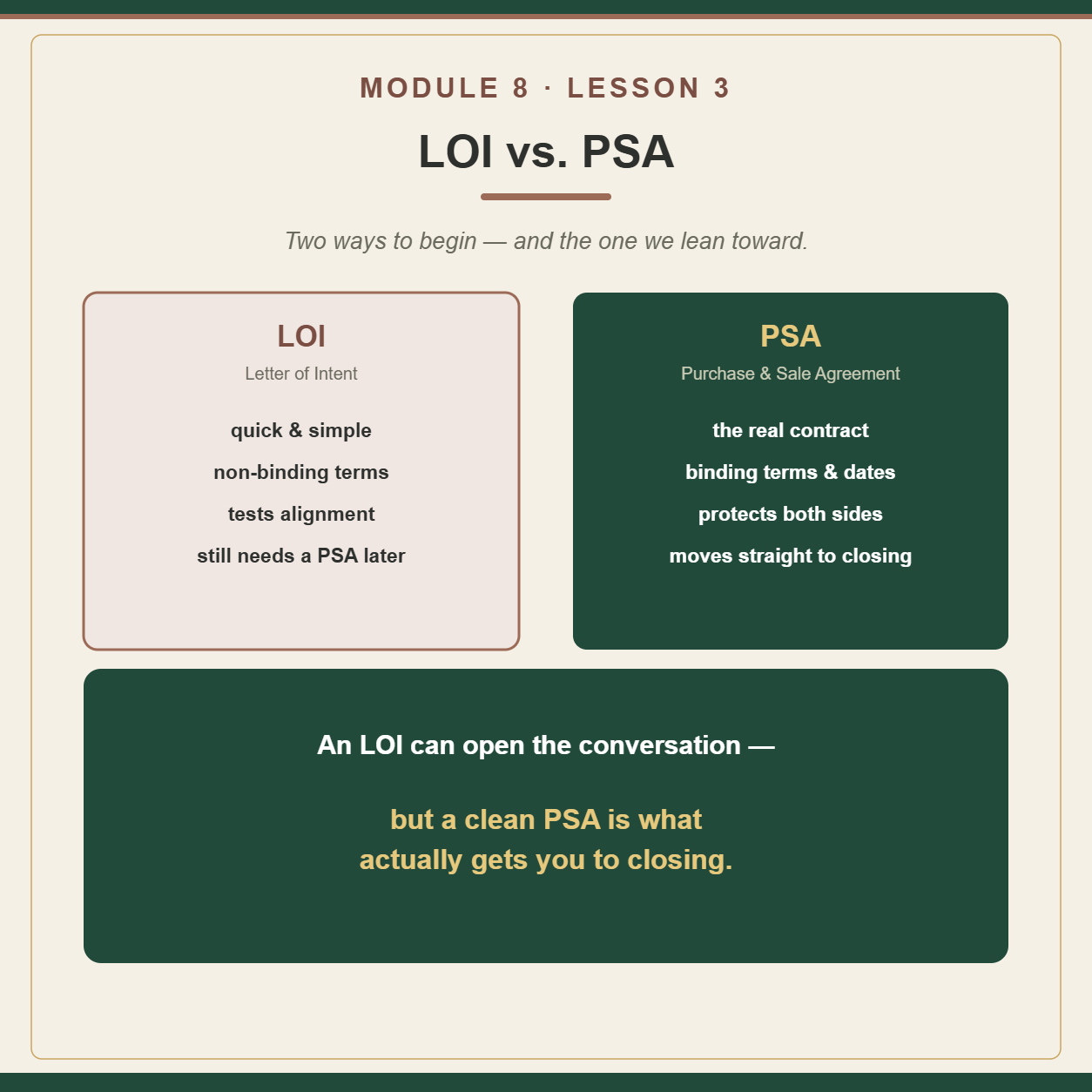
TWO WAYS TO BEGIN — AND THE ONE WE LEAN TOWARD
There are two common ways to begin negotiating a campground purchase: a Letter of Intent (LOI) or a Purchase & Sale Agreement (PSA). Both can work — but in our experience, a well-written PSA is often the stronger way to start, because it immediately puts both parties on a defined path toward closing. Here’s how each works, and why we usually reach for the PSA.
THE LETTER OF INTENT (LOI)
An LOI is a short, mostly non-binding document that lays out the big terms and asks the seller a simple question: “Here’s the deal I’m proposing — are we aligned?”
WHEN AN LOI MAKES SENSE
Just remember: an LOI is generally not a binding purchase agreement. Until a PSA is signed, the transaction can still change.
THE PURCHASE & SALE AGREEMENT (PSA)
The PSA is the real contract. It turns an agreed-upon deal into binding, enforceable terms and sets the path to closing.
WHY WE OFTEN PREFER STARTING WITH A PSA
A well-written PSA:
Instead of open-ended negotiation, everyone starts working toward closing.
SIDE BY SIDE
| Letter of Intent (LOI) | Purchase & Sale Agreement (PSA) | |
|---|---|---|
| Binding? | Mostly non-binding | A binding contract |
| Holds the seller? | No — they can still walk | Yes — locked from the start |
| Earnest deposit | Usually none yet | Yes — held in escrow |
| Due-diligence period | Outlined | Defined & enforceable |
| Deadlines | Loose | Clear and contractual |
| What it creates | A conversation | Certainty & a path to close |
| Best when | Parties are far apart or testing a deal | You want to lock the deal & protect your position |
THE RISK OF STARTING TOO LOOSE
Because an LOI doesn’t lock anyone in, a lot can change before a PSA is signed. A seller can accept your LOI on Monday and change their mind by Thursday — a better offer, a great holiday weekend, a neighbor’s opinion. Nothing was holding the deal. That’s exactly the gap a PSA closes.
“I’ve seen sellers reject an offer on Monday, then call back Thursday because something changed. I’ve also seen sellers accept an LOI and change their minds before the PSA ever arrived. Life changes, business changes, emotions change. A signed Purchase & Sale Agreement gives both parties a roadmap and protects the time you need to complete financing and due diligence. Let your financing or your inspections — not uncertainty — decide whether the deal moves forward.”
A financing contingency protects both sides. If the loan can’t be obtained despite a good-faith effort, the lender — not emotion — decides the outcome. You commit with a PSA, but your contingencies (financing, due diligence, inspections) stay as clean, blameless exits if the facts don’t hold up.
OUR APPROACH — NOT A HARD RULE
To be clear, a PSA isn’t always the answer — some deals genuinely call for an LOI first. This is simply how we tend to work: we often prefer beginning with a well-written PSA because it sets the framework from the very start, while still protecting the buyer through clearly written contingencies. When it’s your academy and your decades of deals, it’s worth saying plainly: here’s how we do it, and why.
Both an LOI and a PSA can begin a transaction. The real question isn’t which is “better” — it’s which one best protects the deal and moves both parties toward a successful closing. In our experience, that’s usually a well-written PSA.