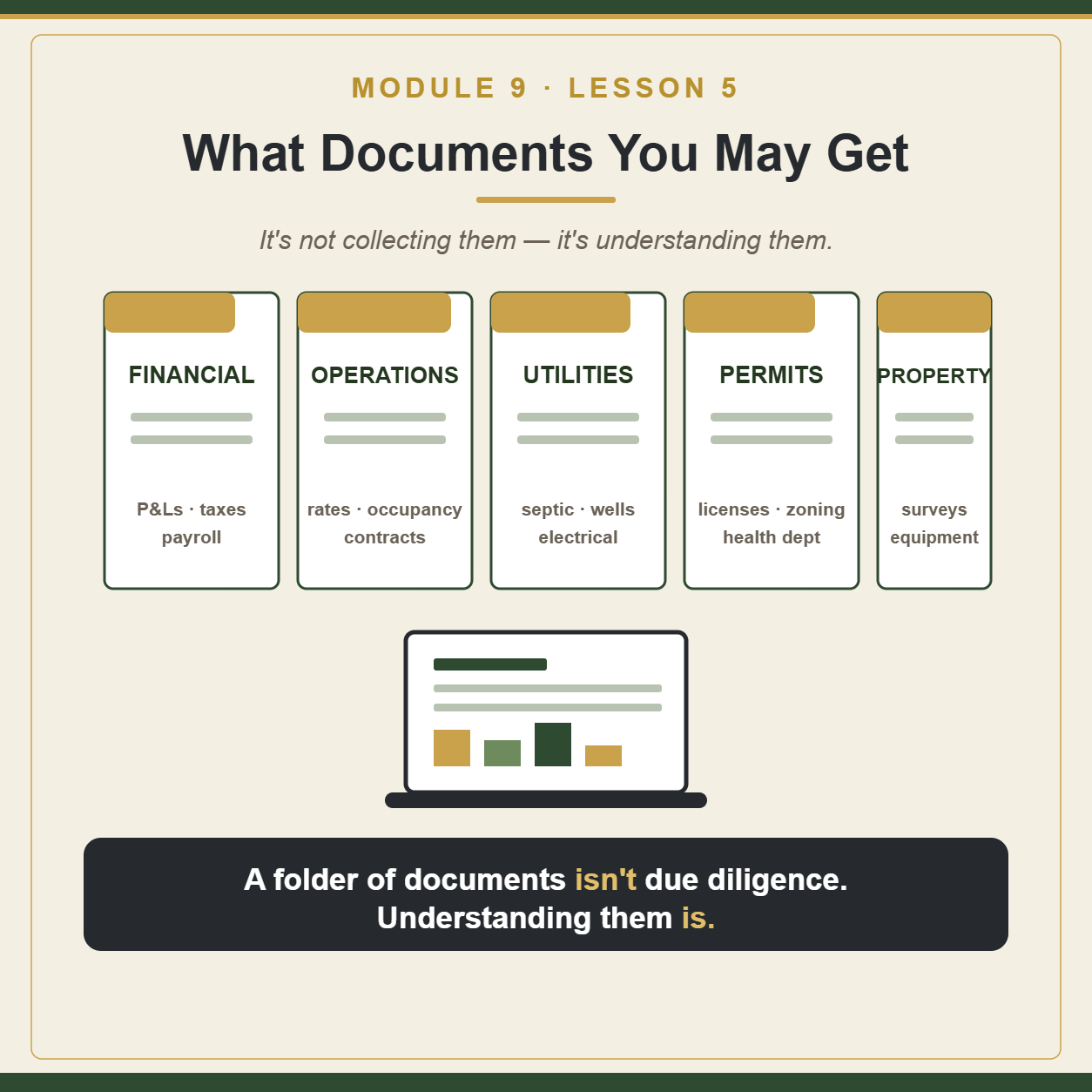
Due diligence creates a lot of paperwork. The key isn’t simply collecting documents — it’s understanding what each one helps you verify.
Depending on the campground, the seller’s recordkeeping, and the terms of the transaction, you may receive a wide range of financial, operational, property, and infrastructure records. Not every campground will have every document, and not every document will be perfectly organized. Your job is to understand what information exists, what it tells you, and what may need additional verification.
Financial records
These help you confirm how the business has actually performed. You may receive profit-and-loss statements (often for the previous 3 years), tax returns when available, trailing 12-month financials, detailed expense reports, add-back or owner-adjustment information, payroll records or summaries, bank statements when needed, and insurance costs and claim history.
What you’re looking for: whether the reported income, expenses, and NOI are reasonably supported by the records. Look for consistency — do the P&Ls make sense against the tax returns? Are major expenses accounted for? Are the adjustments legitimate and understandable? We’ll go much deeper into financial verification later in this module.
Operational records
These help you understand how the campground actually runs. You may receive reservation system reports, occupancy reports, rate sheets, seasonal camper information, staff structure, payroll information, vendor lists and contracts, guest or seasonal agreements, and management agreements if applicable.
What you’re looking for: where revenue comes from, how the business operates, and what ongoing obligations may continue after closing.
Licenses, permits & compliance
Depending on the property, you may receive campground licenses, health department records, zoning information, Special Use Permits, pool permits, food-service licenses, water-system records, environmental reports, and other local, state, or federal permits.
What you’re looking for: confirmation that the campground operates under the appropriate approvals, plus any conditions, restrictions, or renewal requirements that could affect future operations.
Utilities & infrastructure records
Campground infrastructure varies widely, especially in older properties. Records may include septic system records and pump reports, well logs, water tests, water-system diagrams, sewer diagrams, electrical schematics, utility maps, engineering drawings, and site plans.
What you’re looking for: what systems exist, how they’re configured, how they’ve been maintained, and whether additional inspection is needed. Remember — a document does not replace an inspection. A septic record tells you something about the system; a professional inspection tells you something about its current condition.
Property & asset records
You may also receive surveys, site maps, legal descriptions, equipment lists, inventory lists, vehicle lists, cabin or rental-unit inventories, leases or easements, and maintenance records. These help clarify exactly what’s included in the sale and what physical assets or property rights are being transferred.
OLDER CAMPGROUNDS MAY HAVE GAPS
A campground that’s operated for 30, 40, or 50 years may not have a perfect digital file with every historic repair, utility drawing, permit, or engineering plan. That doesn’t automatically mean something is wrong. Older owners may have paper files, incomplete historical records, hand-drawn utility maps, records held by the municipality or health department, and systems installed decades ago before modern digital recordkeeping.
When something’s missing, don’t assume the worst. Ask: Should this document exist? Can it be obtained elsewhere? Can the information be independently verified? Does the gap create a material risk? Those are much better questions.
Don’t just collect — organize
Create a due-diligence checklist and track what was requested, what was received, what still needs clarification, what needs professional review, what appears complete, and what requires follow-up. A folder full of documents is not due diligence. Understanding those documents is.
LESSON TAKEAWAY
You may receive financial, operational, compliance, infrastructure, and property records. Some will be detailed, some incomplete, some may not exist. Your job isn’t to demand a perfect file — it’s to determine whether the information available, combined with inspections and professional verification, gives you a clear understanding of what you’re buying.