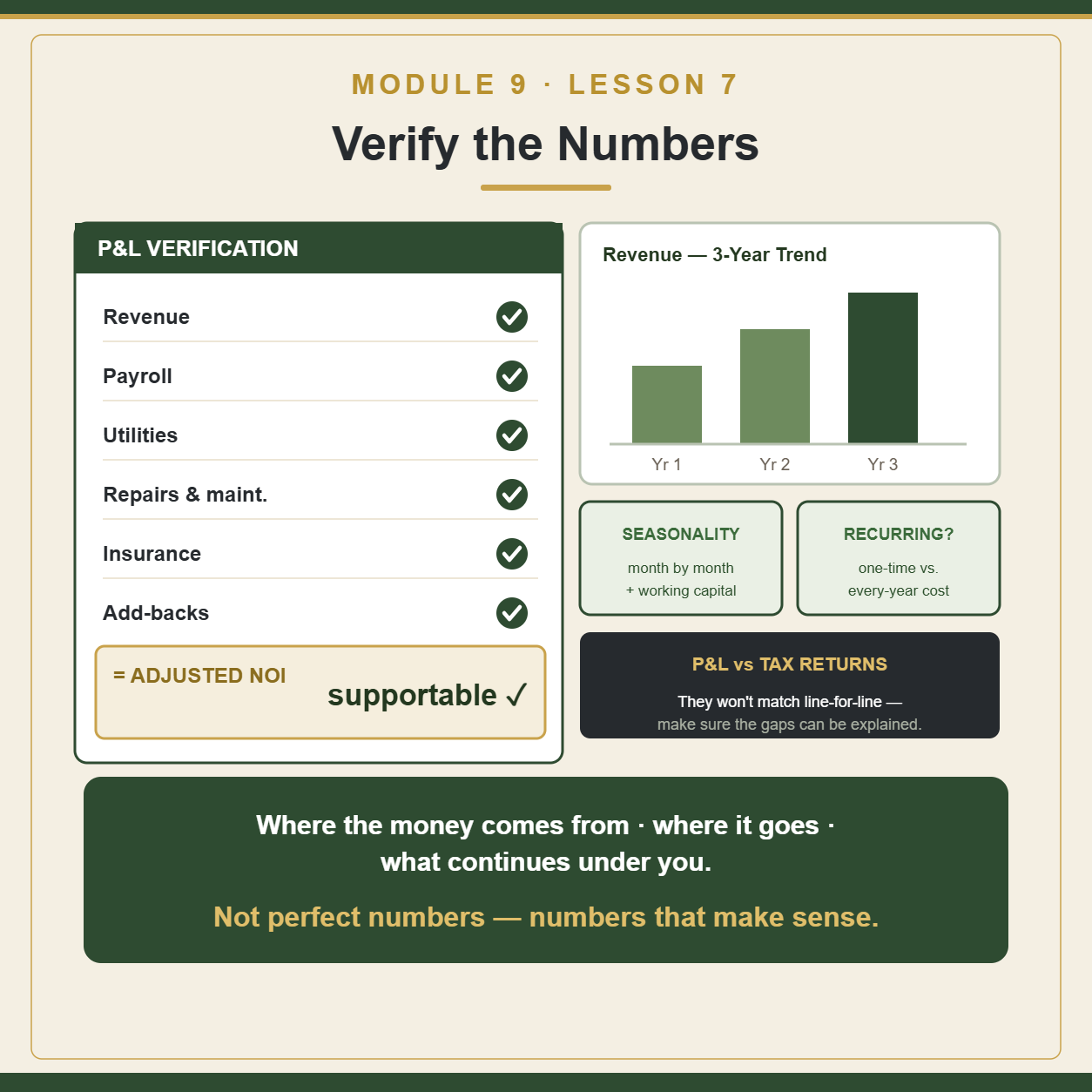
The financials helped you decide what the campground was worth. Now due diligence is where you verify that the numbers support the story.
Financial due diligence isn’t simply looking at a P&L and checking whether the bottom line matches what you were told. You’re trying to understand how the campground actually makes money, where that money goes, which expenses will continue under your ownership, and whether the Adjusted NOI you used to evaluate the property is supportable. This is where you move from reported numbers to verified performance.
Start with the big picture
Review multiple years of financial information rather than one isolated season — P&Ls, tax returns, trailing 12-month financials, detailed general ledger or expense reports, payroll, reservation-system reports, occupancy reports, rate history, utility bills, insurance costs, and owner add-backs. One document rarely tells the whole story; the goal is to cross-check information from multiple sources.
1. Compare P&Ls to tax returns
Compare gross revenue, major expense categories, payroll, repairs and maintenance, utilities, insurance, interest, depreciation, and net income. Don’t expect every line to match perfectly. Accounting methods, tax classifications, depreciation, interest, owner expenses, and timing differences can all cause legitimate differences between the records. What matters is that the differences can be explained and supported. If something doesn’t make sense, ask.
2. Verify the add-backs
Add-backs are expenses in the seller’s statements that may not continue under new ownership — owner salary above market replacement cost, personal vehicles or expenses, one-time legal or professional fees, nonrecurring major expenses, interest, and depreciation. But an expense doesn’t become an add-back just because the seller calls it one. Ask: Is it truly nonrecurring? Will I have this expense after I buy? Will I need to replace the owner’s labor with an employee or manager? Can the adjustment be documented? The purpose is a realistic Adjusted NOI — not the most optimistic NOI possible.
3. Understand labor costs
Payroll can dramatically change a campground’s economics. Understand who works at the park, what they do, what they’re paid, whether housing or benefits are included, whether they’re seasonal or year-round, how much work the owner performs, and who will do that work after closing. If the seller works 50 hours a week and you plan to hire a manager, that future expense has to be counted. Owner labor is not automatically free labor.
4. Verify occupancy & reservation revenue
Use the reservation system and supporting reports — reservations, site nights sold, seasonal sites, monthly campers, transient occupancy, average rates, cancellations, deposits, and ancillary revenue — and compare them to the revenue on the financial statements. You’re looking for a business story that makes sense. If revenue is growing, you should be able to see what’s driving it: higher rates, more occupancy, more sites, more seasonal campers, cabins, or store sales. Revenue growth should have an explanation.
5. Understand seasonality
Campgrounds are often highly seasonal. A strong July doesn’t tell you what the whole year looks like. Review revenue and expenses month by month — when reservations begin, when deposits are collected, peak months, shoulder-season performance, winter expenses, seasonal payroll, utility swings, and the timing of major expenditures. This matters enormously for working capital: you may close during a period when expenses continue but significant revenue won’t arrive for months.
6. Review utilities month by month
Utilities can be one of the larger operating expenses — electric, water, sewer, propane, gas, trash, internet. Look at how costs change through the season, and understand whether utilities are included in site rates, separately metered, charged back to seasonal campers, or paid entirely by the campground. A park with individually metered electric can have a very different expense structure from one where electric is baked into every seasonal rate.
7. Review rate history
Don’t just look at today’s rates — understand how nightly, weekly, monthly, seasonal, and cabin rates (plus fees, storage, golf carts, and other revenue) have changed over time. When were rates last increased? Below-market rates may present opportunity, but don’t assume you can raise every rate dramatically without affecting occupancy or retention. Underwrite based on what exists today; treat future improvements as opportunity, not guaranteed income.
8. Understand deposits & cash-flow timing
A seller may collect deposits months before guests arrive. Understand what future reservations are already booked, how much deposit money has been collected, who receives that money at closing, who’s responsible for honoring the reservations, and whether gift certificates, credits, or prepaid stays exist. Revenue received before closing can create an obligation that continues after. Cash received is not always income earned. Your attorney and accountant should help determine how these items are handled in the transaction.
9. Separate one-time expenses from recurring expenses
This is one of the most important parts of the analysis. A $40,000 roof replacement may not happen every year — but roofs eventually need replacing. A major septic repair may be unusual — but septic maintenance isn’t. A one-time legal bill may truly disappear; routine road maintenance won’t. Your job is to tell the difference between truly nonrecurring expenses and normal ownership expenses that simply don’t happen every year. Those are not the same thing.
LOOK FOR PATTERNS — NOT JUST PROBLEMS
Watch for revenue consistently growing or declining, payroll rising faster than revenue, large unexplained adjustments, unusual expense swings, occupancy that doesn’t match reported revenue, dependence on one revenue source, and deferred expenses that may become yours. A single unusual number deserves a question. A repeated unexplained pattern deserves deeper investigation.
Your lender is looking too
Your lender will do its own underwriting — historical performance, tax returns, Adjusted NOI, debt-service coverage, your liquidity, down payment, appraisal, management experience, and working capital. That’s another reason your numbers need to make sense: the campground must not only work for you, it must support the financing required to buy it.
THE REAL QUESTION
Does the financial performance support the Adjusted NOI and the deal you agreed to pursue?
Don’t look for perfect numbers. Look for numbers that make sense, can be explained, and can be supported.
LESSON TAKEAWAY
Financial due diligence is more than proving revenue exists. You’re verifying where the money comes from, where it goes, which expenses continue, which adjustments are legitimate, and what the campground realistically produces — so you know whether the numbers support the Adjusted NOI and the deal you agreed to pursue.
DOWNLOAD · EXPENSE BENCHMARK COMPS
Use these expense-comp pools to sanity-check a park’s expense ratios against real campgrounds in the same price range. They’re a reference point — every property is different — but they help you spot when an expense line looks unusually high or suspiciously low.
📄 $150K – $300K — RV Expense Comps
📄 $300K – $500K — RV Expense Comps
📄 $500K – $1MM — Campground P&L Comp Pool