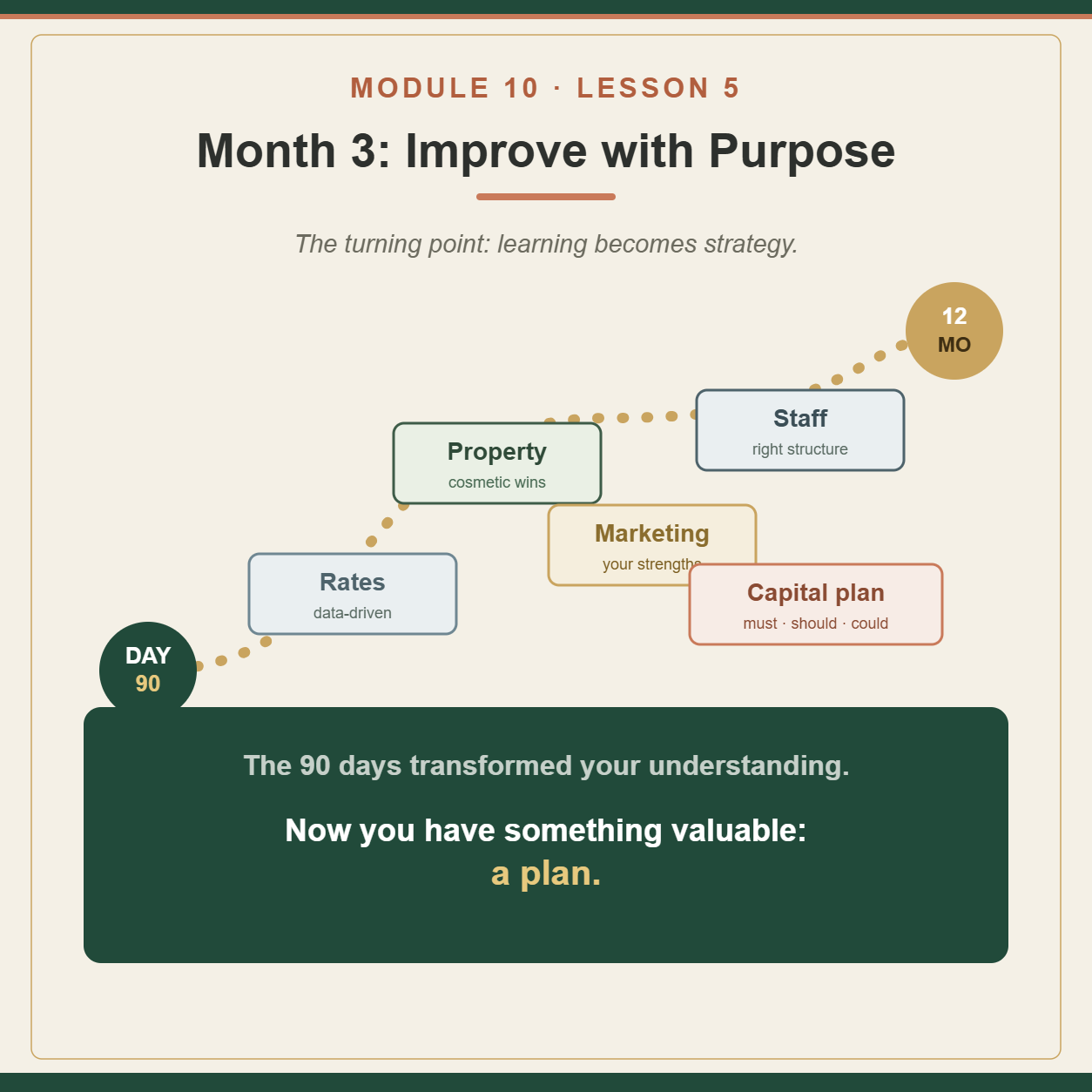
By Month 3 you’ve done something important: you’ve spent enough time inside the business to start making better decisions. Now you can begin small, intentional improvements based on real information. This is your improvement phase — the goal isn’t to change everything, it’s to start improving what now clearly deserves attention.
1. Evaluate rate changes — with data
You now have enough information to make informed pricing decisions. Review occupancy, reservation pacing, site and weekend/holiday demand, seasonal renewals, competitor pricing, guest feedback, operating costs, site quality, and amenity level — then decide whether adjustments are justified.
RATE CHANGES SHOULD BE DATA-DRIVEN
There’s no universal number. A substantially underpriced park that’s consistently full may support a very different adjustment than one still building occupancy. Ask: is demand supporting the increase? are guests getting value? are certain site types underpriced while others aren’t? should the change happen now — or next season? do longtime seasonals need advance notice? Pricing should be strategic, not emotional — and not raised across the board just because you can.
2. Start small cosmetic improvements
Now’s a good time for visible improvements that lift the guest experience without major capital: painting, landscaping, exterior lighting, directional signage, picnic tables, fire rings, trail cleanup, store organization, entry improvements, bathhouse touch-ups, and common-area cleanup. Small doesn’t mean unimportant — guests notice cleanliness, landscaping, lighting, signage, and organization. A $1,000 improvement in the right place can have more guest impact than a much larger project nobody asked for. Focus on what guests see and use every day.
3. Improve the marketing — sell what you do well
You now understand the campground well enough to present it accurately and intentionally: updated photography, clearer website wording, accurate amenities and site descriptions, updated maps, stronger booking links, a current Google Business Profile, and easier online booking. Don’t try to look like something you’re not — market what you actually do well. Peace and quiet, family activities, waterfront, a strong seasonal community, big-rig-friendly sites — your best marketing usually comes from clearly communicating your real strengths.
4. CREATE YOUR 12-MONTH IMPROVEMENT PLAN
This is the bridge from “new owner” to “operator with a strategy.” Take everything you learned in the first 90 days and organize it across five areas:
Infrastructure · Revenue · Capital projects · Operations · Marketing
Don’t turn the plan into a wish list. Every project should answer: why are we doing this? what will it cost? what problem does it solve? what’s the expected benefit? when should it happen? who’s responsible? can the business afford it? A plan should help you prioritize — not just collect ideas.
5. Build a capital priority list
MUST DO — safety, compliance, infrastructure, continued operations.
SHOULD DO — improves reliability, efficiency, or guest experience.
COULD DO — potential upside but no immediate need.
FUTURE — larger expansion or redevelopment needing more research and capital.
This keeps exciting projects from pushing important infrastructure to the bottom of the list.
6. Reassess your staffing
You now have a much clearer picture of your team. Are responsibilities clear? Do you have enough people — or too many somewhere? Are key employees overloaded? Do you need additional skills or training? Who should take on more responsibility? Is management coverage adequate? This is a far better time for thoughtful staffing decisions than Day 3.
7. Review your first 90 days financially
Compare actual performance against what you expected before closing — revenue, payroll, utilities, maintenance, vendor costs, card fees, store revenue, occupancy, average rates, and cash flow. Where were you right? Where were you wrong? What surprised you? What needs to change in the budget? Your first operating experience should now start sharpening your forecasts.
8. Reassess your own experience
This part matters too. After 90 days, ask yourself: what surprised me about ownership? what took more time than expected? what do I enjoy most, and what drains my time? what should I delegate or stop doing personally? where do I need more knowledge? what will I do differently next season? You’re not just learning the campground — you’re learning how you operate as an owner.
WHAT YOU SHOULD NOT HAVE DONE BY DAY 90
✗ Completely renovated the park · ✗ added every wish-list amenity · ✗ replaced every employee · ✗ raised every rate · ✗ rebuilt the brand · ✗ expanded the property · ✗ solved every maintenance problem.
You should have something more valuable: a plan.
LESSON TAKEAWAY
Month 3 is when learning becomes strategy. Make thoughtful pricing decisions, begin visible improvements, sharpen your marketing, strengthen the operation, review your numbers, and build a realistic 12-month plan. The first 90 days were never supposed to transform the campground — they were supposed to transform your understanding of it. Now you know enough to improve with purpose.