You finally own the campground, and the temptation is to start changing things immediately. That enthusiasm is good — but the first 90 days aren’t for proving how fast you can change the park. They’re for understanding the business you just bought.
You have ideas. You saw opportunities during the buying process. You probably already have a list of improvements. Hold that list — first, you need context.
Your goal in the first 90 days is not…
✗ To overhaul everything · ✗ To raise prices aggressively
✗ To redesign the park · ✗ To replace staff immediately
✗ To add major amenities or expand
✗ To change every system · ✗ To fix every problem at once
✗ To spend money simply because you planned to before closing
Some of those may eventually make sense. But first, context.
YOUR REAL GOAL, IN ORDER
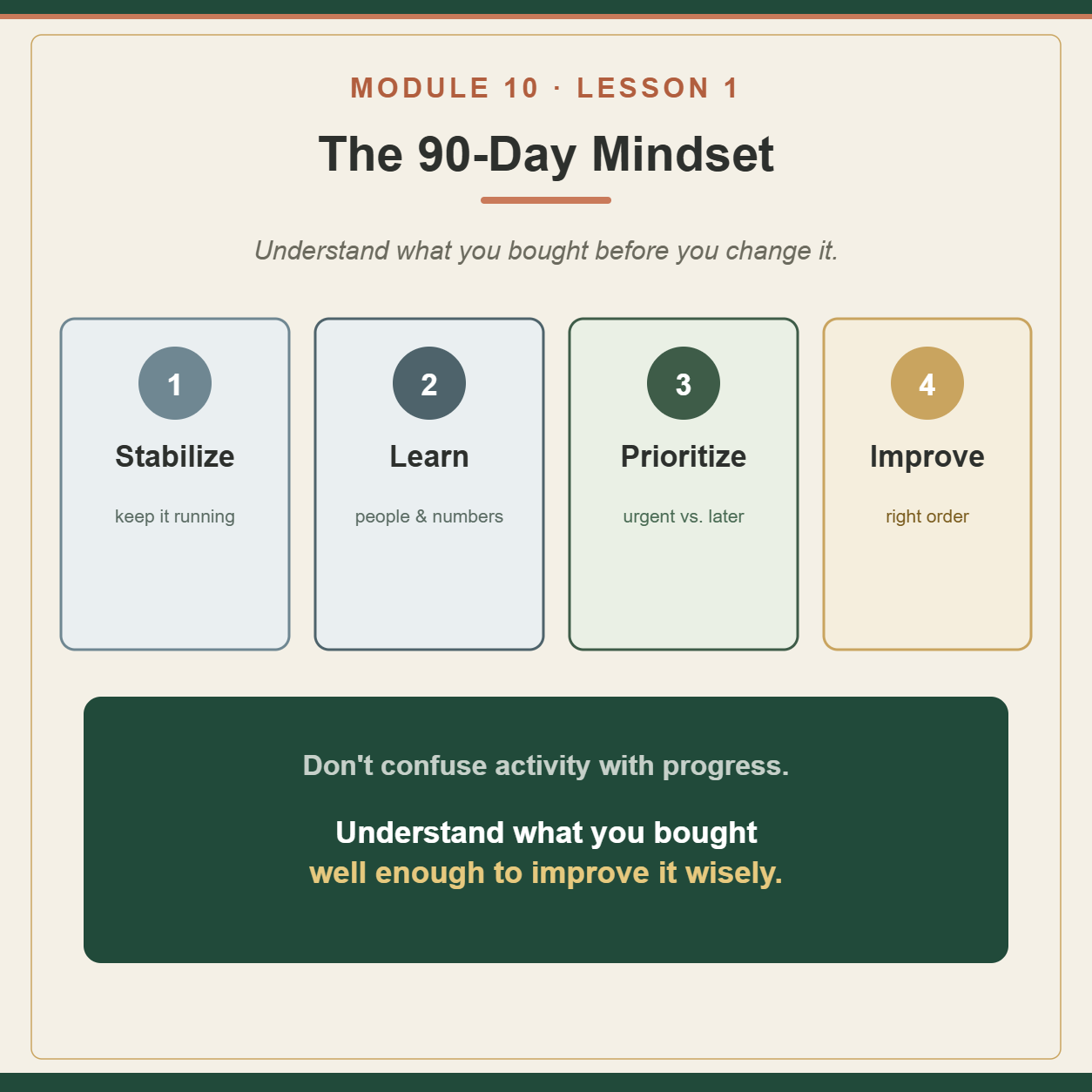
Stabilize → Learn → Prioritize → then Improve
That sequence matters.
1. Stabilize
Your first responsibility is to keep the campground running smoothly: guests served, reservations honored, employees clear on expectations, payroll working, vendors paid, utilities functioning, emergencies covered, maintenance continuing, and money collected and tracked correctly. Before you improve the operation, make sure the operation is stable.
2. Learn
Now observe. Talk to the staff, walk the campground, listen to guests, review the reservation system, watch how money moves. Understand what works well, what frustrates employees, what guests complain about, what longtime campers love, which maintenance issues keep returning, which systems are efficient or outdated, where money is being lost, and where the real opportunities are. Ownership will show you things due diligence never could.
3. Prioritize
Once you understand the park better, sort what needs attention:
Urgent — safety, utilities, compliance, major guest-impact, anything threatening operations
Important — revenue, efficiency, staffing, maintenance, guest experience
Improvement — makes the park better but not immediately
Future — expansion, major amenities, redesigns, long-term capital
Everything does not belong in “urgent.” Learning to prioritize may save you more money than any improvement you make.
4. Then improve
Once you understand the business and know what matters most, make thoughtful changes — updating a process, fixing a recurring issue, adjusting staffing, improving communication, updating rates at the right time, improving guest experience, replacing outdated equipment, planning future projects. Now your decisions come from actual ownership experience, not assumptions.
DON’T CONFUSE ACTIVITY WITH PROGRESS
New signs, new landscaping, new uniforms, new policies, new pricing, new software — changing ten things in your first month doesn’t mean you’re improving the campground. Sometimes the smartest move is to leave a system alone long enough to understand why it works.
The 90-day rule
Before making a major change, ask yourself: Is this necessary right now? What problem am I actually solving? What information do I have? Have I talked to the people affected? Could waiting another 30 days give me better information? Not every decision needs to wait — but major changes deserve context.
LESSON TAKEAWAY
Stabilize (keep it running), learn (understand the people, systems, guests, and numbers), prioritize (decide what actually matters), improve (make informed changes in the right order). The goal isn’t to put your stamp on the park as fast as possible — it’s to understand what you bought well enough to improve it wisely.