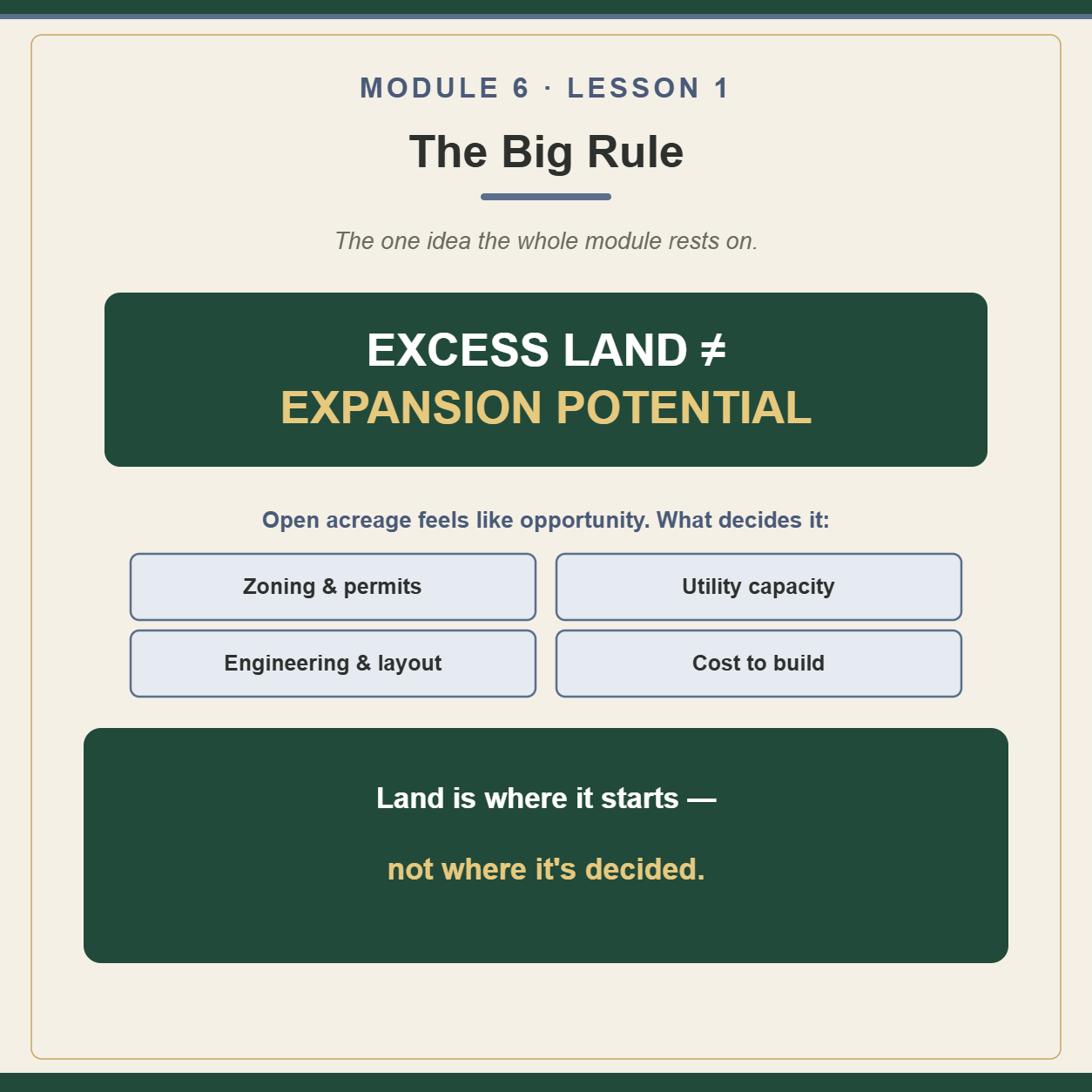
EXCESS LAND DOES NOT EQUAL EXPANSION POTENTIAL
One of the biggest misconceptions buyers make is believing that more acreage automatically means more campsites. It doesn’t. You can own 25 acres — or even 100 — and still not be allowed to add a single one of these:
- RV sites
- Cabins
- Glamping accommodations & park models
- Storage buildings
- Bathhouses
- Recreation areas
Why? Because expansion depends on approvals, not acreage. It’s the rule Harold has repeated for fifty years: unused land has no value if you can’t legally or practically use it.
BEFORE YOU ASSUME YOU CAN EXPAND, ASK
Every “there’s room to grow” claim has to survive these questions before it’s worth a dollar of your offer:
- Does the zoning allow additional development?
- Does the property’s master plan support expansion?
- Is there enough water capacity?
- Can the sewer or septic system handle the additional flow?
- Is electrical capacity available?
- Are there environmental restrictions — wetlands, floodplains, or protected areas?
- Will the health department allow more campsites?
- Is there adequate road access, and will parking requirements change?
THE OTHER HALF OF THE RULE: CAN VS. SHOULD
Even when a park can be expanded, that doesn’t mean it should be. Before you price in a single new site, look at occupancy. If a park is running half full, the answer isn’t more sites — it’s filling the ones it already has. Occupancy tells you whether expansion is a real opportunity or an expensive distraction. Adding sites to a park that can’t fill what it has just builds a bigger problem.
EVERY NEW SITE HAS A COST
Many buyers assume adding sites is cheap. It rarely is. A single new site can require:
- Engineering and surveying
- Permits
- Utility extensions — water, sewer, and new electrical service
- Roads and drainage
- Site preparation and landscaping
Depending on what the ground and the utilities demand, a single new full-hookup site commonly runs $20,000 to $80,000 to build — and the number swings with amp service, hookup level, and how far the sewer, water, and electric have to run. “Plenty of room to expand” is not the same as plenty of cheap room to expand.
EXPAND FOR WHO ACTUALLY STAYS THERE
What you add should match who actually camps there — the age and type of guest decides the upgrade. A park full of young families points toward cabins, glamping, a playground, a splash pad. A park full of seasoned RVers points toward big pull-through sites, full hookups, and 50-amp power. Building glamping tents for a retiree RV crowd, or premium pull-throughs for a tent-and-family park, is money spent in the wrong direction. Know the guest before you pour the pad.
AND BE HONEST ABOUT YOURSELF
Here’s the part that never shows up in a listing: your own stage of life gets a vote. A major expansion is years of permitting, construction, debt, and sweat. If you’re buying near retirement and want a calm, cash-flowing park, a five-year build-out may be the last thing you want. If you’re younger and hungry, it might be exactly the right project. The “right” amount of expansion isn’t only what the land allows — it’s what you actually want to take on.
THEN ASK THE QUESTION ALMOST NOBODY ASKS
Expansion isn’t the goal. Profitable expansion is. Before you add 20 sites, run the math:
- Will they actually increase NOI?
- Will they raise the property’s value?
- Will they pay for themselves — and how soon?
- How long until you recover the investment?
If the numbers don’t work, “room to expand” is just a story someone told you to justify the price.
WHAT GOOD EXPANSION LAND ACTUALLY LOOKS LIKE
The best expansion opportunities aren’t about having more land. They’re about having land that is:
- Buildable
- Serviceable
- Accessible
- Financeable
- Profitable
Don’t buy a campground because someone says “there’s plenty of room to expand.” Buy it because you’ve verified that expansion is actually possible — and profitable.
“Before you ask if you can expand, ask if you should. Occupancy answers that faster than any survey — if you’re not filling what you’ve got, more sites won’t save you. Then look at who’s actually staying with you; they’ll tell you what to build. And be honest about your own age and how hard you want to work. Land doesn’t create value — approved, buildable, profitable campsites do. Expansion is a tool, not a trophy.”