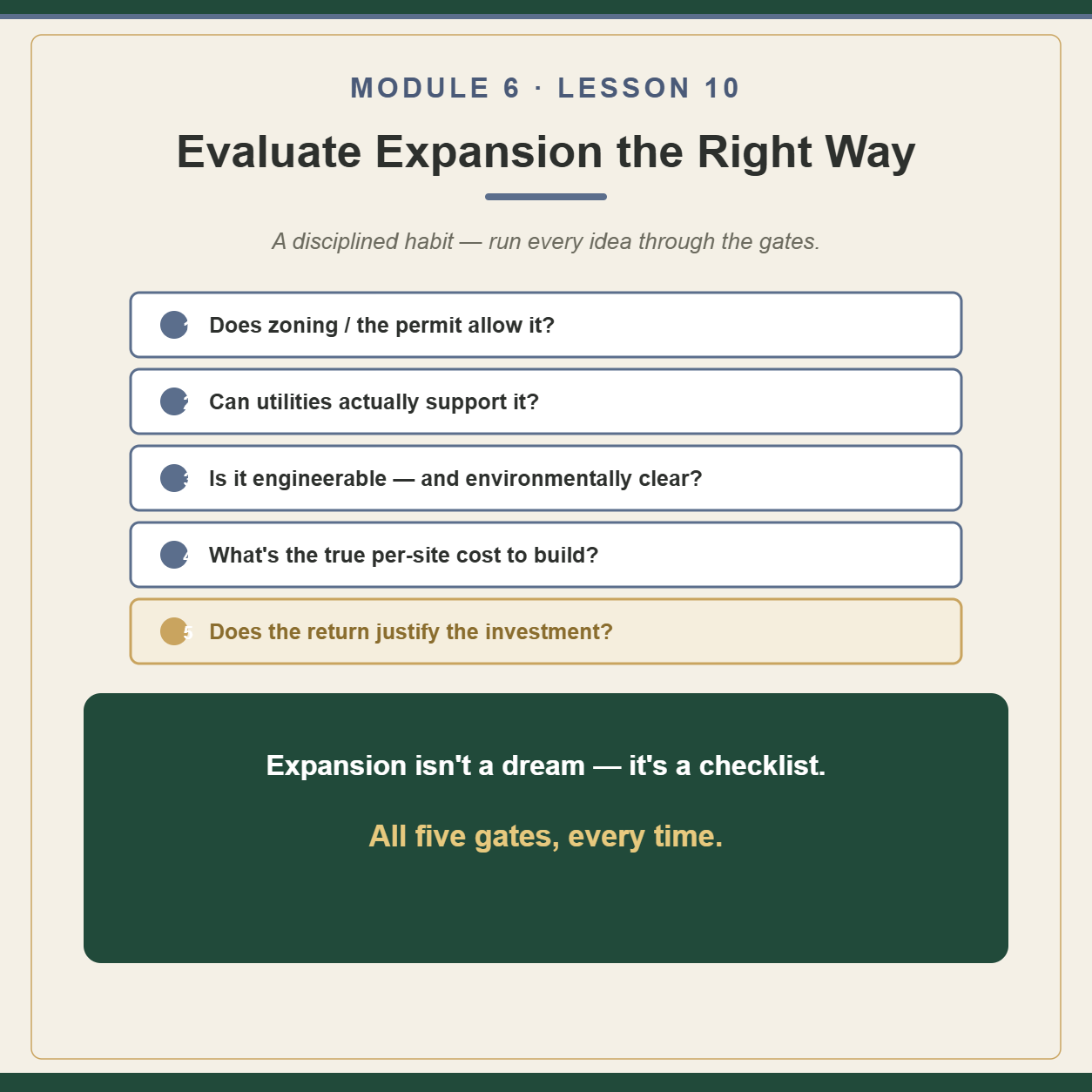
THE RIGHT WAY TO EVALUATE EXPANSION
Everything in this module comes down to one disciplined habit: never trust “room to grow” until you’ve run it through the gates. Excitement isn’t evaluation. Here’s the checklist that turns a seller’s “potential” into a clear yes or no.
THE EXPANSION CHECKLIST
Walk every potential expansion through these — starting with what’s cheapest to disprove:
- Is the zoning supportive, and does the county actually allow it?
- Is the use conforming, or would it need a special-use permit?
- Does the land meet environmental standards — wetlands, floodplain, buffers?
- Is the topography buildable, with enough net buildable acreage?
- Is fresh-water capacity sufficient?
- Does septic, sewer, or a city tap support the added flow?
- Can the electrical service handle the new load?
- Is there road access and a layout that works?
- Has an engineer confirmed all of the above?
If any one of these fails, there is no expansion — no matter how much land or how exciting the idea.
THEN THE GATE EVERYONE FORGETS: DOES IT PAY?
Passing the “can I?” checklist only earns you the right to ask the real question: should I? Run the money before you commit:
- What will it cost all-in — construction, soft costs, and the cost of borrowing?
- What nightly rate and occupancy are realistic for this market?
- How many years until it pays itself back?
- Does it raise NOI and the property’s value — or just add work?
An expansion that’s possible but not profitable is just an expensive way to stay busy.
You don’t evaluate expansion alone, and you don’t take the seller’s word for it. Bring these three in before you pay for potential — each one kills a bad assumption cheaply:
The planning department — what’s legally possible: zoning, permits, what the county will and won’t allow.
An engineer — what’s physically possible and what it truly costs: utilities, soil, drainage, layout.
Your banker — whether it’s financeable and whether the numbers actually work. Bankers are conservative by trade, and that conservatism protects you from your own optimism.
NEVER PAY TODAY FOR POTENTIAL YOU HAVEN’T VERIFIED
Here’s the rule that ties this whole module together: value the park on what it is, not what it could be. A seller’s “room for 40 more sites” is worth nothing until planning, your engineer, and your banker all agree it’s real. If the expansion checks out, it’s your upside to capture — not a premium to pay. If it doesn’t, make it a contingency or walk. Unproven potential is the most overpriced thing in any listing.
Real expansion potential is the rare case where every gate opens at once — legal, physical, financial, and personal. Run the checklist, run the numbers, and let your planner, engineer, and banker confirm it before you ever pay for it. Until then, “potential” is just a story.
“Don’t evaluate expansion in your own head — and don’t do it off the seller’s brochure. Get three people in the room before you spend a dime: the planning office to tell you what’s allowed, a good engineer to tell you what it’ll really take, and your banker to tell you if the money works. I’ve seen more deals saved by a banker’s ‘no’ than lost by it. Plan it, price it, and prove it — then build it.”