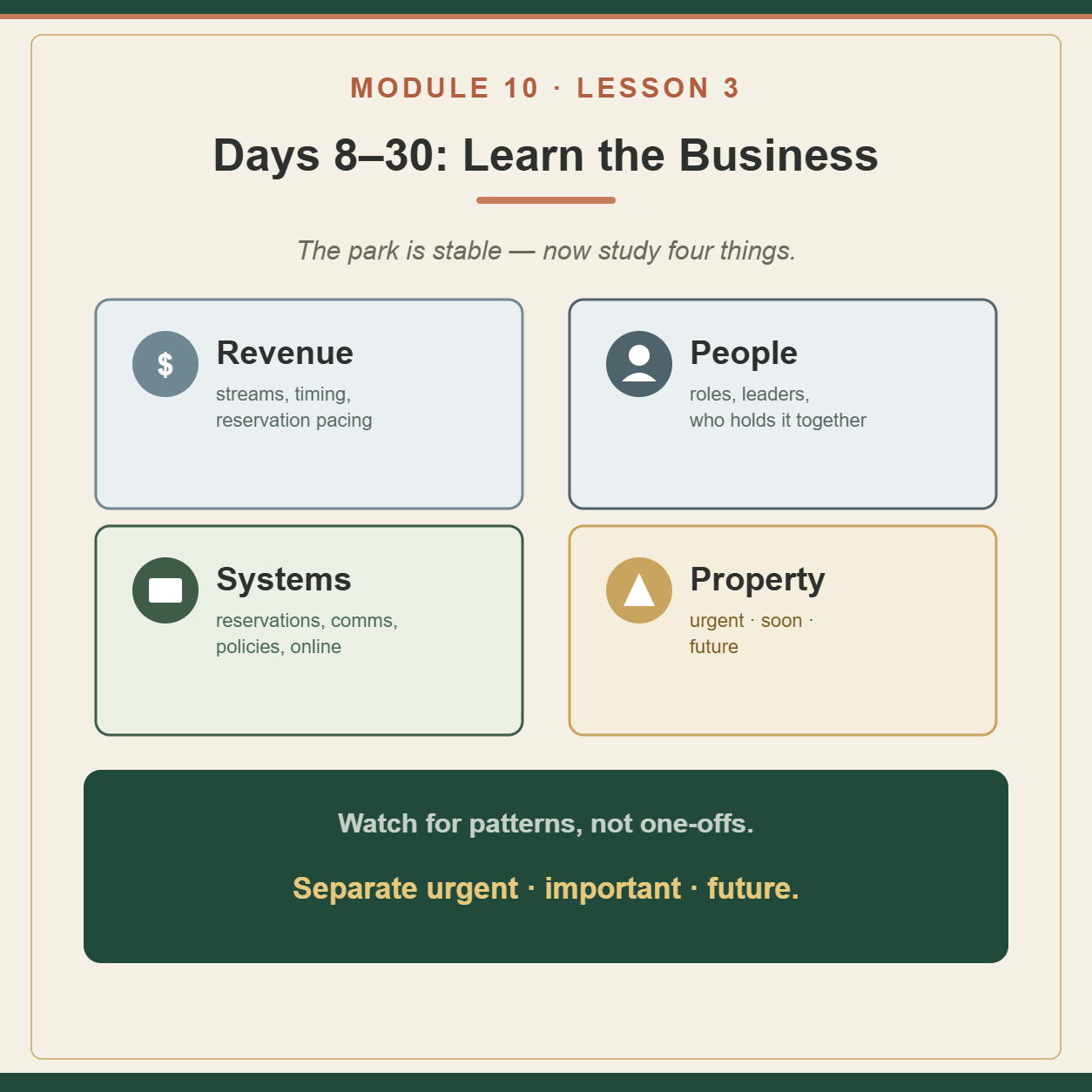
Week 1 was about gaining control. Weeks 2 through 4 are about understanding how the campground actually works. Now that the park is stable, start studying the business.
You’re no longer just making sure the doors open and the systems function — you’re studying the business. During Days 8–30, focus on understanding four things:
Revenue
People
Systems
Property
Don’t rush this stage. The better you understand the campground now, the better your decisions will be later.
1. Learn your revenue cycle
Campground revenue is rarely “sites × nightly rate.” Study every stream — daily, weekly, monthly and seasonal stays, cabins, store, firewood, propane, golf carts, laundry, events, and other ancillary income — then learn the timing: when guests book, when deposits and final payments land, which weekends sell out first, which weekdays struggle, which months carry the revenue, and when cash flow slows. This is your campground’s revenue rhythm — learn it before you change rates or policies.
Reservation pacing tells you how far ahead guests book (do holiday weekends fill months out? do weekdays come last-minute? do seasonals renew a year ahead? do cabins book before RV sites?). It’ll shape rates, promotions, minimum stays, staffing, and marketing later — but first, just learn the pattern.
2. Learn your staff workflow
You’ve met the team — now learn how it actually functions. Who does what, who naturally leads, who guests go to with a problem, who knows the reservation system, the store, the utilities, who opens and closes, who’s dependable, and where responsibilities are unclear. The org chart on paper may not reflect reality — sometimes one employee quietly holds together half the business, and you need to know who that is.
Watch before you reorganize. Something that looks inefficient may have a good reason behind it — or it may not. Either way, understand why it’s done that way before you change it.
3. Review your operating systems
Reservation system: rate settings, site categories, minimum stays, discounts, deposit and cancellation rules, automated messages, and online booking/availability. Don’t assume every setting is right just because it’s been there for years.
Guest communication: phone scripts, voicemail, confirmation and arrival emails, check-in messaging, rules, cancellations, texts, and website FAQs — is it clear, consistent, and easy for a new guest to understand?
Online presence: website, Google Business Profile, social media, booking links, directories, and review sites — check for outdated rates, photos, policies, phone numbers, amenities, site counts, and hours. You may not need a redesign; you do need accurate information.
4. Review expenses & vendors
Learn where the money goes — trash, propane, electric, water/sewer, laundry, software, pest control, landscaping, internet, insurance, card processing, reservation software, equipment service, supplies, and pool service. For each vendor: what they provide, what it costs, how often they’re used, whether there’s a contract, when it renews, and whether the service is still necessary.
Identify inefficiencies — but verify them first. Note duplicate software, pricey vendors, unused subscriptions, high utilities. Write them down and investigate — but avoid major changes until you understand the consequences. Sometimes the “expensive” vendor is the only one who answers the phone on Saturday night. Cost is only one part of value.
5. Begin your infrastructure assessment
Combine your due-diligence reports, your own walk-through, staff feedback, maintenance history, and what you’ve observed — then build your repair/improvement list in three categories, not one giant pile:
URGENT — safety, utilities, compliance, active leaks, electrical hazards, failing infrastructure, anything that could interrupt operations.
SHOULD FIX SOON — guest comfort, reliability, efficiency, staff workload, repeated maintenance (aging fixtures, poor drainage, weak WiFi, worn bathhouses, damaged-but-usable pedestals).
FUTURE IMPROVEMENTS — landscaping, bathhouse remodels, signage, added cabins, pool upgrades, expansion. Your capital plan — not your first month.
START TRACKING PATTERNS
One complaint may mean little; ten about the same thing means something. One electrical problem may be isolated; repeated pedestal failures point to a bigger issue. Keep asking: is this a one-time problem, or a pattern?
Keep a 30-day observation log — what went well, what went wrong, common guest questions, staff and maintenance issues, revenue notes, and ideas. Don’t solve everything now. Capture it. By Day 30, the themes will show you where your attention belongs.
WHAT NOT TO DO YET
Unless there’s a clear operational, safety, or financial reason: ✗ overhaul pricing · ✗ replace major software · ✗ restructure the whole staff · ✗ cancel important vendors impulsively · ✗ launch major construction · ✗ add amenities just because competitors have them · ✗ decide off one complaint. You’re still learning.
LESSON TAKEAWAY
Days 8–30 are about learning the campground beneath the surface — the money, the people, the systems, the property. Study the numbers, watch the people, review the systems, understand the property, and look for patterns. Keep separating urgent from important from future. The goal isn’t to find as many problems as possible — it’s to understand the business well enough to know what deserves your attention next.