WHAT A SPECIAL USE PERMIT REALLY IS
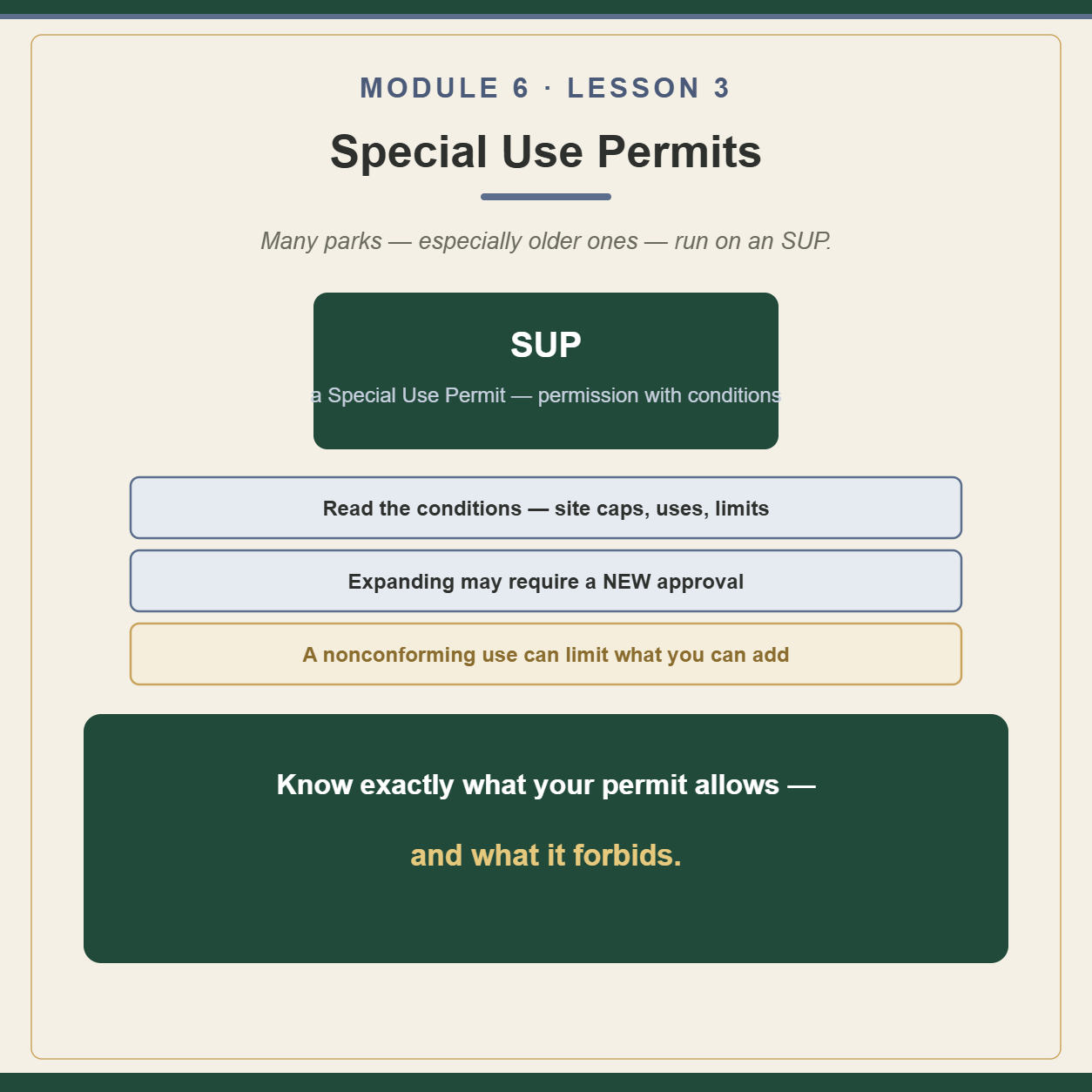
Many campgrounds — especially older ones — don’t operate “by right.” They operate under a Special Use Permit (sometimes called a Conditional Use Permit), often issued decades ago. Here’s the part buyers miss: a special permit is discretionary, not a right. “Allowed with a special permit” is not the same as “allowed.” A planning board granted it, a planning board can condition it, and a planning board can deny a change to it.
WHAT THE PERMIT CONTROLS
The permit — not the zoning map, not the acreage — often sets the hard limits on the park:
- Allowed number of campsites
- Types of structures (cabins, park models, buildings)
- Operating season
- Approved utilities
- Density
- Expansion options
- Noise and event policies
Whatever the permit says is the ceiling. The land underneath it doesn’t change that.
Before you fall in love with a park, get the actual permit and compare it to what’s on the ground. Plenty of parks operate outside their permit — more sites, extra cabins, a longer season, an events business that was never approved. The seller may have gotten away with it for years. The day you close, you inherit it. Worst case, you’re ordered to remove sites, or pulled into a hearing that reopens the whole permit — and the board may not re-approve even what’s already there.
THE PERMIT MAY NOT TRANSFER WITH THE SALE
Don’t assume the permit comes with the keys. In many places a special permit does not automatically transfer to a new owner — it can be tied to the operator, or require re-application and re-approval when the property changes hands. A buyer can close and discover the very permit that made the business legal has to be re-earned — and could be denied or re-conditioned. Confirm in writing whether the permit conveys, and make it a condition of closing.
ANY CHANGE CAN OPEN THE WHOLE PERMIT
This is the one that surprises new owners. Touch the permit — add a few sites, charge for a new amenity, extend the season — and you may not just be approving the new piece. Reopening a permit can trigger a full compliance review, forcing the entire park up to today’s codes: current setbacks, fire and life-safety, ADA, stormwater, utilities. One small upgrade can quietly require expensive upgrades everywhere. And some counties will not reopen an old permit at all — freezing the park at exactly what it is today.
APPROVAL ISN’T FREE — OR FAST
Even when an amendment is possible, it comes with a price and a clock. Approvals often carry required conditions — a traffic study, road improvements, buffers, lighting or stormwater work — that can cost more than the expansion earns. And the process runs months to well over a year. Both the conditions and the timeline belong in your projections, not your wishful thinking.
HOW SMART BUYERS PLAY IT
If a price assumes “you can add 30 sites with a permit,” don’t pay for the dream — make the seller prove it or get it. Put it in the contract: the seller obtains the amendment before closing, or the price and terms adjust. Then watch for the opposite, which is a hidden goldmine — a park that already holds an approved permit for more sites than are built. That’s entitlement someone else spent years and money to win, and you can buy it at a discount. “Approved but unbuilt” is some of the best value in this business.
A Special Use Permit can be the most important document in the deal — and the one most buyers never read. Get the permit. Compare it to what’s built. Confirm it transfers. And never assume a board will say yes to a change.
“A special permit is a privilege, not a possession. Any upgrade or change you make can trigger a complete compliance review — and the permit may not even transfer to you when you buy. So read it before you fall for the park, and keep the officials who hold it informed and on your side. The owner who respects the permit keeps it. The one who pushes his luck is the one who loses it.”