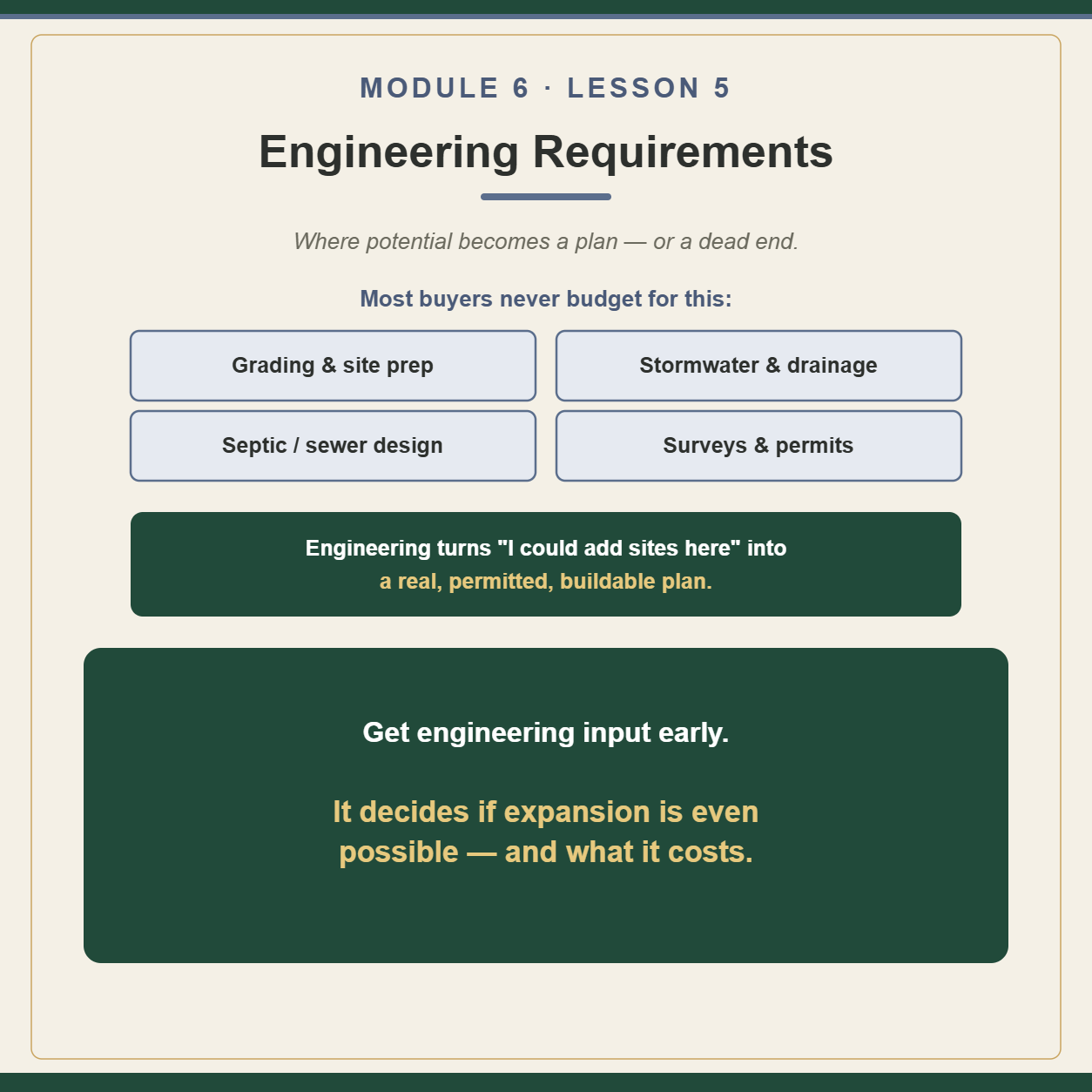
ENGINEERING: WHERE POTENTIAL BECOMES A PLAN — OR A DEAD END
Most buyers treat engineering as paperwork to handle after they buy. That’s backwards. Engineering is the cheapest place to find out whether the expansion you’re paying for is even real — because the studies that cost a few thousand dollars in due diligence are the same ones that can turn “30 new sites” into nine, or into zero.
WHAT EXPANSION ACTUALLY REQUIRES
Before a builder touches the ground, expansion often needs:
- Civil engineering / site plans
- Environmental studies (wetlands, floodplains)
- Soil and percolation testing
- Stormwater management plans
- Erosion-control plans
- Traffic studies
- Architectural drawings for cabins, bathhouses, clubhouses
No builder will break ground without stamped engineering. And these studies aren’t a rubber stamp — a failed perc test, a wetland line, or a floodplain can rewrite your whole plan. The engineering and studies alone commonly run from the tens of thousands into six figures for a larger expansion, before a single shovel moves.
A soil/perc test, a wetland review, a floodplain check — each costs a few thousand dollars, and each can rewrite your entire expansion. Spending that during due diligence is the cheapest insurance in the deal. Make the engineering that proves your expansion a contingency, not a hope you test after closing.
THE THREE TIERS OF A “FUTURE SITE”
Here’s the framework that separates sharp buyers from hopeful ones. A “future site” isn’t one thing — it lives in one of three tiers, and they’re worth wildly different amounts:
- Raw potential — an idea on a map. No engineering, no permits. Worth almost nothing until it’s proven.
- Shovel-ready — surveyed, engineered, and permitted, ready to build. That status carries real value on its own — roughly $7,500 per site — because someone already spent the time and money to de-risk it.
- Built — the finished, income-producing site. Construction runs roughly $20,000 to $80,000 each, depending on hookup level and amp service, plus utilities, roads, and terrain.
Most buyers and sellers blur these together — and that’s exactly how people overpay. A park advertising “room for 30 more sites” as raw dirt is selling a guess. A park handing you 20 shovel-ready sites is handing you about $150,000 of de-risked, time-saved value — before you build. Price the tiers separately.
NEVER CONFUSE “APPROVED” WITH “FREE”
Even a fully engineered, permitted site still costs $20,000 to $80,000 to actually build. Shovel-ready buys you certainty and time — not free sites. Budget the entitlement value and the construction cost as two separate lines, hire an engineer who has done campgrounds before, and remember the whole bill comes before the new revenue does.
Engineering turns “potential” into a number. Find out that number before you close — raw dirt, shovel-ready, and built are three different prices, and only one of them is a guess.
“Engineering is where the dreaming stops and the truth starts. A shovel-ready site — surveyed, engineered, permitted — is worth real money, about $7,500 a site, because the hard part is already done. But don’t kid yourself: building each one still runs $20,000 to $80,000 once the dirt moves. Hire an engineer who’s done campgrounds, do the studies before you close, and never pay built-site prices for a line on a map.”