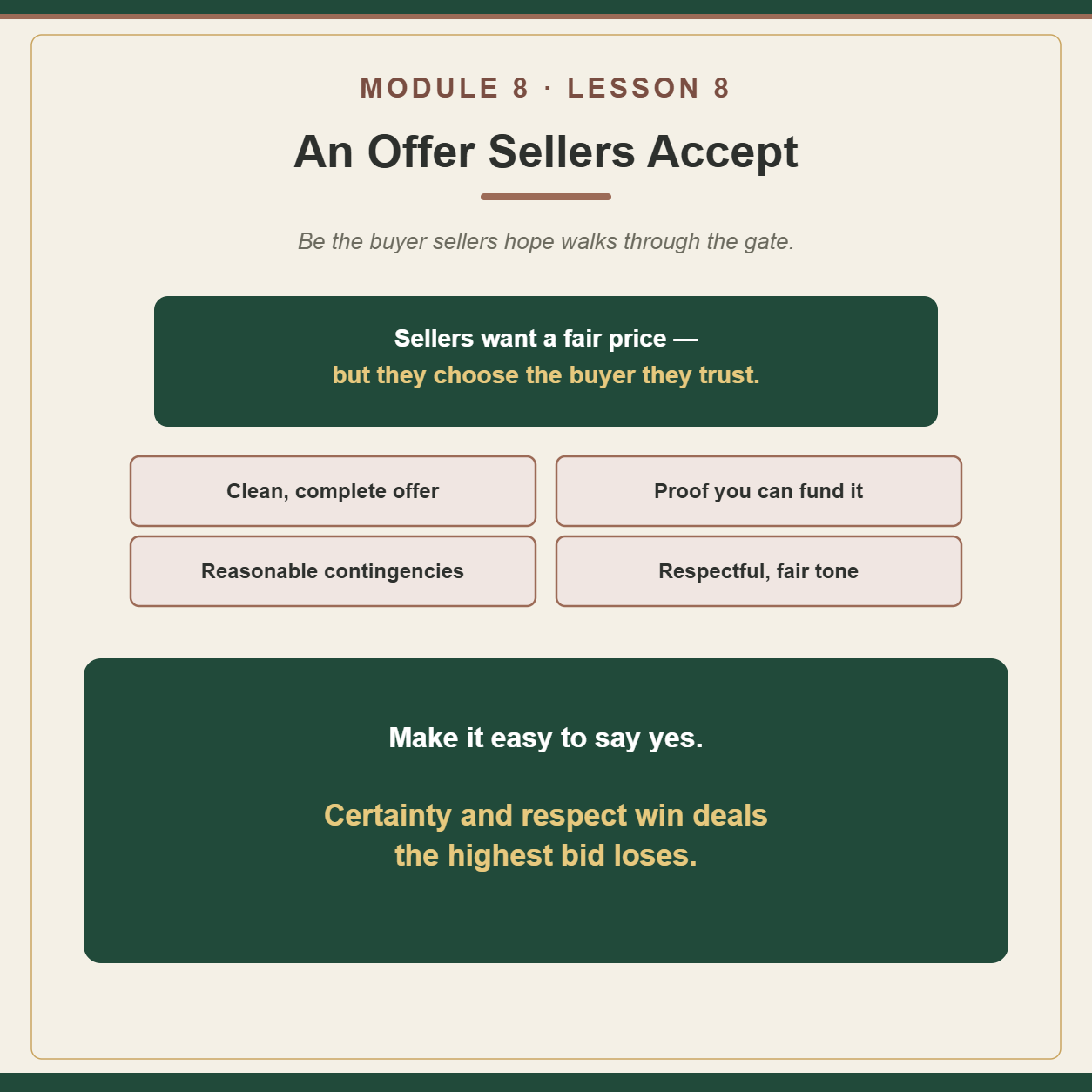
BE THE BUYER SELLERS HOPE WALKS THROUGH THE GATE
Every seller wants a fair price. But every seller also wants confidence — confidence that you’ll close, that you’ll respect the process, and that you’re the right person to take over what they spent years, sometimes decades, building. That confidence is what separates accepted offers from forgotten ones. Your job is to make it easy for them to say yes.
KEEP IT CLEAN — UNDER 20 PAGES
A short, clear offer gets read and understood. A bloated one gets set aside, over-lawyered, or picked apart. Keep it under twenty pages and keep the language plain. Clean and short signals a serious, professional buyer.
DRAFT IT IN WORD
Put the offer in an editable Word document, not a locked PDF. You want corrections to be easy, because a deal moves through revisions on the way to final terms. An offer you can both mark up keeps the momentum going.
YOUR FIRST OFFER IS A DRAFT, NOT AN ULTIMATUM
Treat your first offer as a working example — a starting point that guides you and the seller toward a final version you both sign. Framing it that way lowers the pressure and invites the seller to work with you, instead of feeling cornered into a yes-or-no.
BUILD IT AROUND THE SELLER’S NEEDS
This is the move most buyers miss: shape the offer around what the seller needs, not just what you want. Their closing timeline, their tax situation, a short leaseback or transition period, the legacy they’re handing off. An offer that clearly accounts for the seller’s needs is far more likely to get a yes — and it shows you’re someone they can trust to close.
BUYERS WHO STAND OUT
PROFESSIONALISM CREATES CONFIDENCE
The buyers who win don’t create uncertainty. They answer questions before the seller has to ask, they show they’re prepared, they communicate clearly, and they follow through. Professionalism creates confidence, confidence creates momentum, and momentum closes deals.
Sellers rarely choose on price alone. They quietly ask three questions:
Answer yes to all three, and your offer immediately becomes stronger.
“Keep your offer under twenty pages, and put it in Word — not a locked-up PDF — because corrections need to be easy, and there will be corrections. Treat that first offer as an example, a working draft that guides the two of you toward a final version, not some line-in-the-sand ultimatum. And more than anything, show the seller you’re doing your best to understand their needs — their timeline, their situation, what matters to them. Do that, and you’re not just making an offer — you’re making it easy for them to say yes.”
The goal isn’t simply to submit an offer — it’s to become the buyer a seller feels confident accepting. Price opens the conversation; preparation, professionalism, and certainty close the deal.
“The buyer who inspires the most confidence often wins — even when they aren’t the highest bidder.”