CABINS & GLAMPING: ARE THEY WORTH THE INVESTMENT?
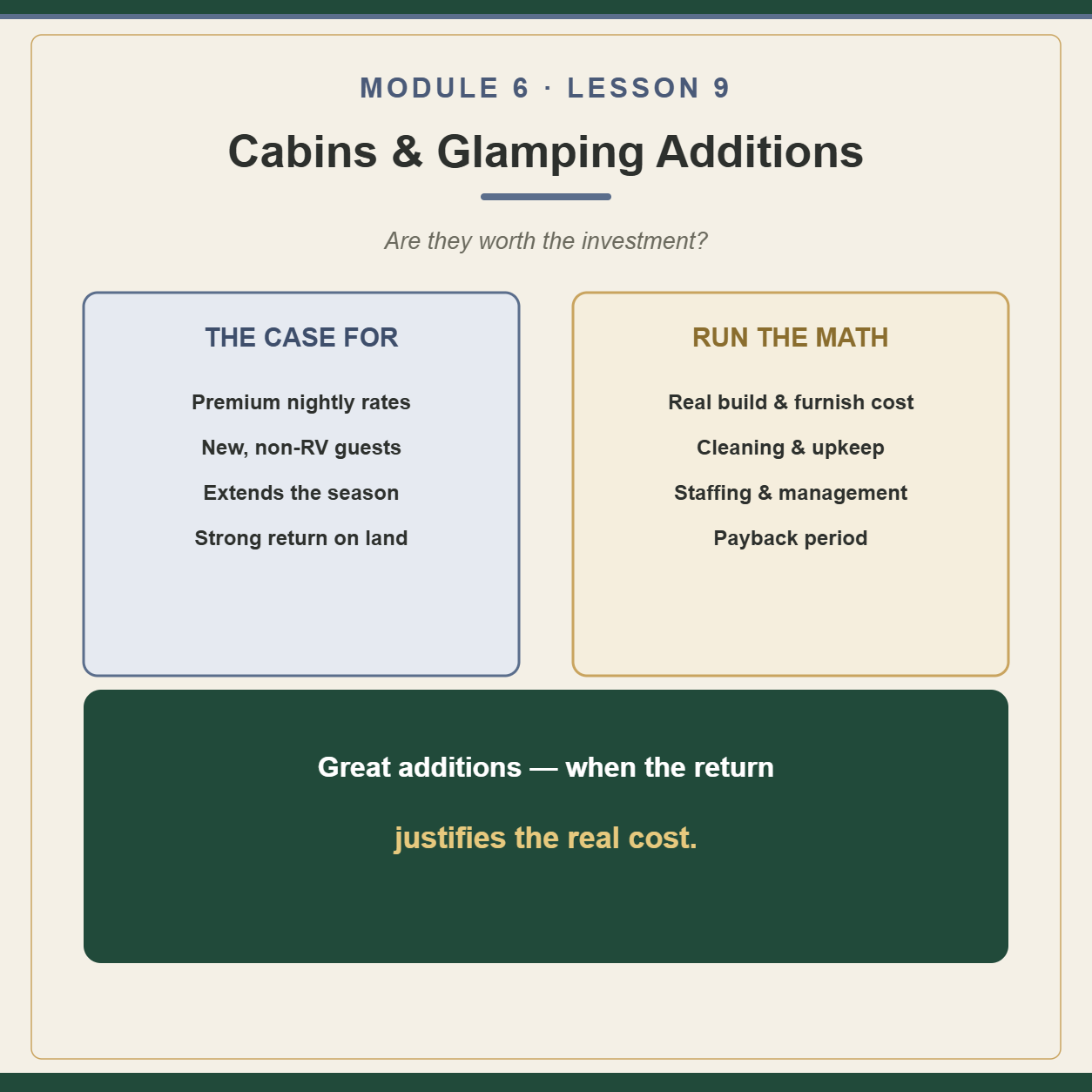
Here’s the shift most buyers miss: adding cabins or glamping isn’t buying a structure — it’s starting an entirely new business inside your campground. The revenue can be excellent, but the investment and the day-to-day operation are far bigger than the sticker price suggests. The real question isn’t “can I build it?” It’s “will my market pay the rates that make it worth it?” Higher revenue does not always mean higher profit.
WHY THEY’RE WORTH CONSIDERING
- Command far higher nightly rates than an RV site
- Reach the majority of travelers who don’t own an RV
- Extend your season — people book a heated cabin when they won’t pitch a tent
- Drive marketing — a striking unit is what guests photograph and share
- Monetize land a 40-foot rig could never reach
THE CATCH: YOU BECOME AN INNKEEPER
RV guests bring their own beds; cabin and glamping guests rent yours. A cabin answers to the building department — codes, egress, sometimes ADA — and glamping is a regulatory gray zone. And every unit you add multiplies the operational load: reservations, guest communication, housekeeping, maintenance, inspections, inventory, and marketing. Before you build, decide who actually runs it — you, or someone you hire.
The bar is high, too. A guest paying $250–$400 a night expects excellent Wi-Fi, a quality mattress, modern furnishings, outdoor seating, attractive landscaping, and spotless housekeeping. You’re not renting a cabin — you’re selling an experience, and the reviews will hold you to it.
WHAT IT TAKES TO BUILD
- Site preparation
- Foundations or platforms
- Electrical service
- Water and sewer (for full-service units)
- Road or path access
- Parking
- Landscaping
- Accessibility requirements (ADA where applicable)
- Fire-code compliance
- Utility extensions
APPROXIMATE CONSTRUCTION COSTS
- Basic camping cabin — $25,000 to $45,000
- Deluxe cabin — $60,000 to $150,000+
- Glamping tent / yurt — $10,000 to $40,000+
- Tiny home / park model — $80,000 to $150,000+
Costs vary widely with location, finishes, utilities, and site conditions.
Most buyers budget for the cabin and stop there. The cabin is only the beginning. Build these into your ROI from day one:
Furnishings · decks & patios · fire pits · utility hookups · Wi-Fi & internet · appliances · insurance · ongoing maintenance · housekeeping & turnover · reservation software
PLAN FOR REPLACEMENT
Buyers budget to build; few budget to replace. Cabins and glamping wear out on a schedule — mattresses, furniture, appliances, HVAC, decks, roofs, flooring, and linens all have a clock. Every unit needs a long-term replacement budget, or its “profit” quietly funds its own decline.
REGULATIONS MATTER
Most states and local jurisdictions require some combination of:
- Building permits
- Site plans
- Health-department approvals
- Electrical inspections
- Plumbing inspections
- Fire inspections
- Short-term lodging compliance
Always verify local requirements before you buy or build — and confirm any existing units are permitted. An unpermitted cabin is a liability you inherit.
RUN THE ROI — BEFORE YOU BUILD
Every unit is an investment, so answer the investor’s questions before you commit: What nightly rate is realistic for this market? How many nights a year can you actually rent it? How long until you recover the cost? Will it raise your Net Operating Income?
And watch the trap: a high nightly rate means nothing without nights on the calendar. A $250 cabin rented 60 nights earns $15,000; a $150 cabin rented 220 nights earns $33,000. Occupancy — not the headline rate — is what determines profit.
You’re not buying a cabin — you’re buying its future cash flow. Run it the way an investor would:
Cabin cost: $100,000
Annual revenue: $45,000
Operating expenses: –$18,000
Net operating income (NOI): $27,000
Now ask the real question: is a $27,000 return on a $100,000 build good enough for you — and how many years until it pays itself back? Investors don’t buy cabins. They buy cash flow.
The most valuable move in this lesson, and the one first-time buyers rarely hear: don’t build ten glamping tents because the photos look great. Build one. Learn from it. Measure real occupancy. Refine the guest experience. Then expand. The best operators grow one proven unit at a time instead of pouring hundreds of thousands into a product before they understand their own market. Growth should follow proven demand — not assumptions.
Cabins and glamping can become some of the highest-producing assets in a campground — but only when they fit the market, the budget, and the business plan. The best cabin isn’t the most expensive one; it’s the one that consistently produces the strongest return on investment. Weigh demand, occupancy, all-in cost, operations, and replacement — then build the one the numbers support.
“Don’t fall in love with the brochure. A cabin or a glamping tent isn’t a structure you buy — it’s a little business you run, with cleaning, repairs, and reviews. I don’t buy cabins; I buy the cash flow they’ll throw off. So start with one, prove your market will pay for it and keep coming back, then build the next. Build for the numbers, not the trend.”