Knowing what due diligence isn’t is just as important as knowing what it is. Buyers can damage an otherwise good transaction when they misunderstand the purpose of this stage.
Due diligence gives you important rights and protections. It’s your opportunity to verify the campground, investigate concerns, ask questions, bring in professionals, and understand exactly what you’re buying. But it also needs to be handled correctly. Used poorly, due diligence can turn a cooperative transaction into an adversarial one, overwhelm the seller, stall the timeline, and create problems that have nothing to do with the campground itself.
Before we get into how to conduct due diligence, let’s be clear about what it is not.
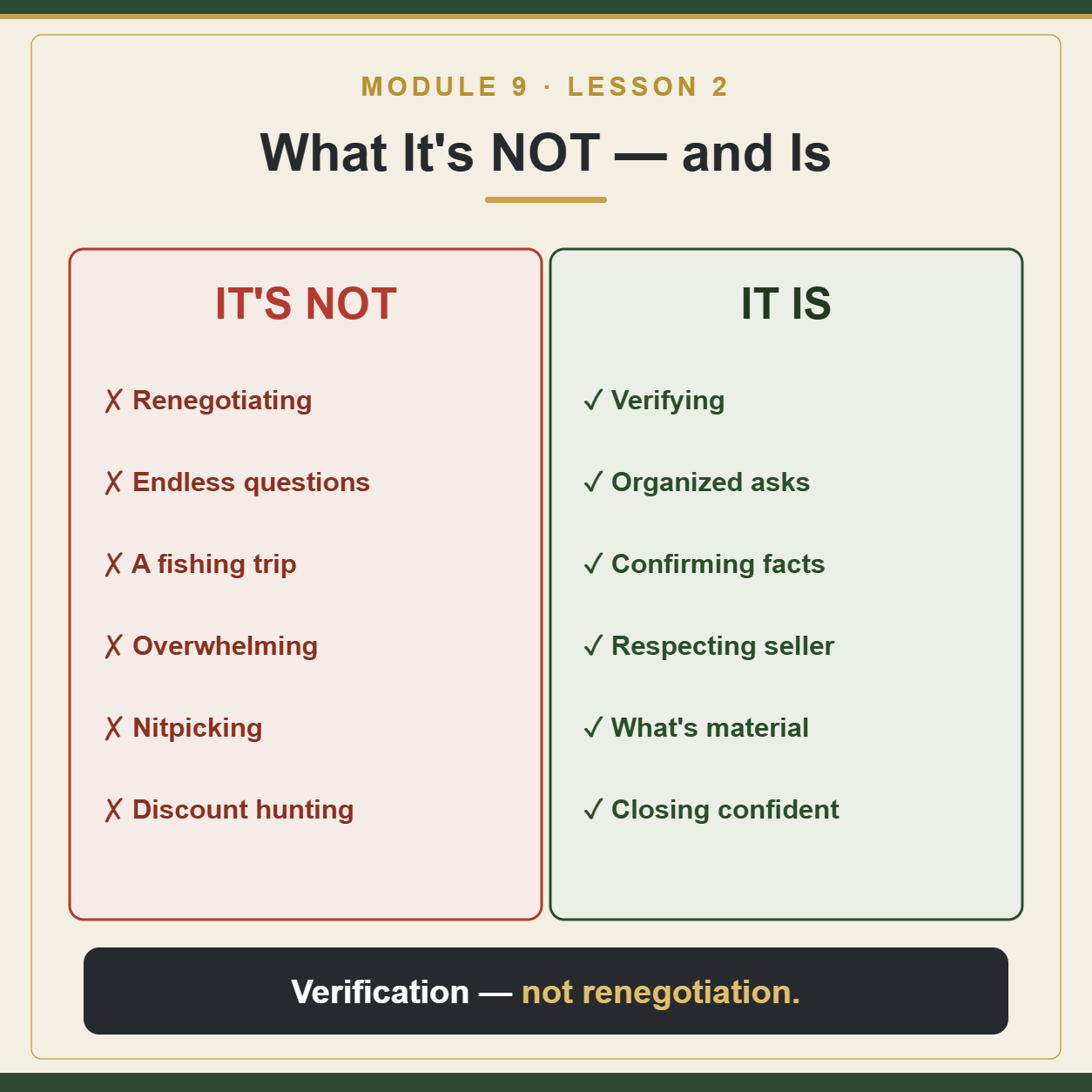
Due diligence is NOT…
✗ A chance to renegotiate the entire deal. You already negotiated the major terms based on the information available when you made your offer. Due diligence is where you verify those assumptions. If you uncover something material that was unknown, inaccurate, or substantially different from what was represented, that may justify another conversation — but discovering a list of normal repairs does not automatically reopen the purchase price.
✗ A fishing expedition. You’re not searching for something — anything — that gives you a reason to change the deal. You’re investigating specific parts of the business and property to determine whether they support the assumptions behind your offer. There’s a difference between being thorough and looking for ammunition.
✗ A time to send hundreds of scattered questions. Thorough due diligence isn’t measured by the number of emails you send — it’s measured by whether you investigated the right things. Organize your questions, group requests together, and keep track of what’s been received, what’s outstanding, and what needs more explanation. Organization is part of due diligence.
✗ A reason to overwhelm the seller. Remember what’s happening on the other side. The seller is usually still operating the campground while gathering financial statements, permits, utility records, contracts, tax documents, and licenses — and answering you, your lender, your attorney, and other professionals. That doesn’t mean you avoid asking for information you legitimately need. It means you ask for it clearly, reasonably, and in an organized way.
✗ A time to ignore small details. Small details can sometimes point to larger issues. If something doesn’t make sense, ask about it. But learn to distinguish between a question that needs an answer and an issue that materially changes the deal. Those are not the same thing.
✗ A game of “find something wrong and ask for a discount.” Every campground will have imperfections — an aging pedestal, a roof that will eventually need replacement, a section of road that needs work, deferred maintenance, older equipment, a bathhouse that could use updating. Those findings are part of understanding what you’re buying. They don’t automatically mean the seller should reduce the price. The question is whether you discovered something materially different from what you reasonably believed you were buying when the offer was made.
…AND NOT A GUARANTEE OF PERFECTION
No amount of due diligence will eliminate every future surprise. You’re buying an operating campground — buildings, utilities, roads, equipment, trees, weather exposure, guests, and moving parts. Things will break after you buy it. Expenses will come up that nobody predicted.
Your goal isn’t to eliminate every possible risk. It’s to identify and understand the material risks you reasonably can before closing.
Why this matters so much
Campground transactions require cooperation. During due diligence, information moves between the buyer, seller, lender, attorney, accountant, inspector, appraiser, title company, surveyor, and any engineers or specialists needed. How you manage that process matters. When buyers communicate clearly, stay organized, and raise legitimate concerns professionally, problems are far easier to solve. When every question becomes a confrontation and every repair becomes a negotiation, the transaction gets difficult fast — even when there’s nothing fundamentally wrong with the campground.
Protect yourself without becoming adversarial
Being cooperative does not mean ignoring problems:
• If the numbers don’t reconcile — investigate them.
• If the septic system concerns you — inspect it.
• If a permit is missing — ask for it.
• If the acreage doesn’t match — verify it.
• If the electrical system needs review — hire someone.
• If something material is discovered — address it.
You can protect yourself completely while still behaving professionally. Thorough and difficult are not the same thing.
So what IS due diligence?
A focused, organized, and professional verification of the campground you’ve already agreed to pursue. Your job is to verify what matters, investigate what doesn’t make sense, understand the risks, use professionals where needed, identify material issues, and then make an informed decision based on facts — not fear, emotion, or a hunt for imperfections.
LESSON TAKEAWAY
Due diligence is verification, not renegotiation. It’s not a fishing expedition, a discount hunt, or a search for a perfect campground. Ask the questions you need to ask, investigate legitimate concerns, protect yourself — but keep the real purpose in mind: determine whether the facts support the deal you agreed to make.