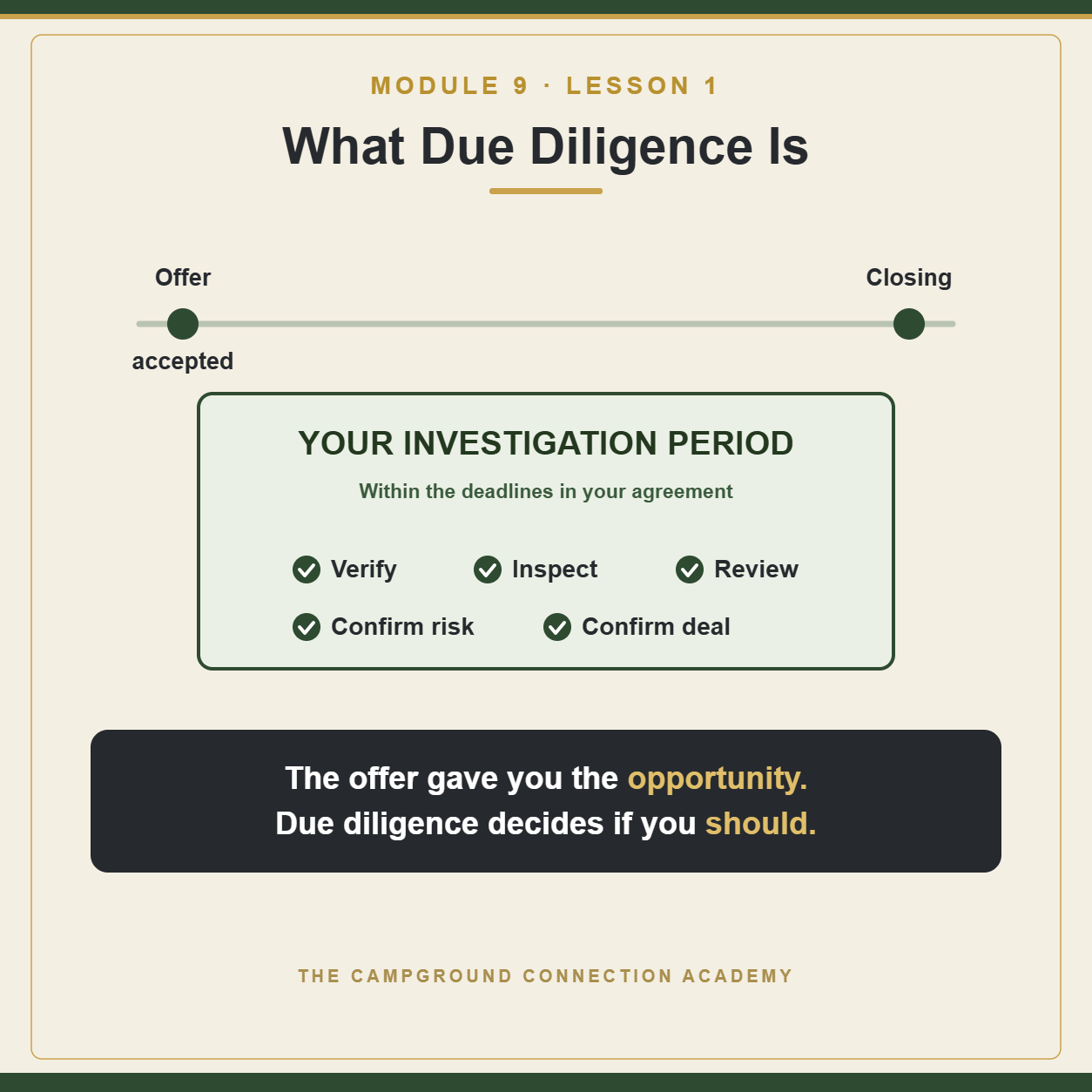
Once your offer is accepted, the real work begins. Due diligence is the period where you move beyond the information used to make your offer and begin independently verifying what you are actually buying.
Due diligence is your formal investigation period — the stretch of time after an offer or purchase agreement is accepted but before the transaction becomes final. During this period, you have the opportunity to examine the campground’s financials, physical condition, infrastructure, records, and operations, according to the rights and deadlines outlined in your agreement.
Think of it this way. Your offer said: “Based on what I know today, I want to buy this campground.” Due diligence asks: “Now that I can investigate it more deeply, do the facts support the deal I agreed to pursue?”
What you are actually doing during this period
Almost everything you do during due diligence falls into one of seven jobs:
- Verify the numbers. Confirm that the income, expenses, and financial performance you relied on when making your offer are reasonably supported by the campground’s records.
- Inspect the property. Evaluate the campsites, buildings, roads, amenities, equipment, grounds, and other physical improvements.
- Confirm the utilities and infrastructure. Understand the water, sewer or septic, and electrical systems — how they operate, how they’re maintained, and what condition they’re in.
- Review the documents. Examine permits, licenses, leases, contracts, tax information, title documents, surveys, and other records affecting the business or property.
- Understand the risks. Identify issues that could create unexpected costs, operational challenges, or limitations after closing.
- Confirm your financing. Keep working with your lender so the property, financial performance, and loan structure satisfy their requirements. Due diligence and financing often run at the same time — and delays in one can affect the other.
- Confirm the deal. Compare what you discover with what you understood when you made your offer, and ask: Is this substantially the business and property I believed I was buying? That’s the real question.
THE KEY IDEA
Due diligence is not about trying to find a reason to walk away. It is about verification. You’re confirming the numbers, the condition, the infrastructure, and the legal and operational records — and identifying what you’ll need to address after closing.
The goal is to walk into ownership with your eyes open.
Your due-diligence rights come from your agreement
This is important. Do not assume that due diligence automatically lets you cancel the transaction for any reason, or that your deposit is always refundable. Your rights depend on the language in your LOI, purchase agreement, or other transaction documents. Pay close attention to:
• Due-diligence deadlines
• Financing contingencies
• Inspection rights
• Deposit provisions
• Notice requirements
• Extension provisions
• Conditions for terminating the agreement
Missing a deadline can change your rights. That’s why your attorney, lender, and other professionals should be involved early in the process.
Don’t confuse due diligence with a second shopping period
You should already have done enough research before making your offer to know the campground fits your general goals, budget, and operating plan. Due diligence is not the time to start asking, “Do I even want to own a campground?” It’s the time to ask, “Does the campground I’m investigating match the campground I agreed to purchase?” That distinction matters.
LESSON TAKEAWAY
Due diligence is your opportunity to verify, inspect, and confirm before closing — where assumptions become facts, unknowns become questions, and questions become answers. Done correctly, it doesn’t make you afraid of the campground. It makes you understand it.