The mechanics of due diligence matter. But your mindset matters just as much.
You can have the best checklist, the best inspectors, and every document in front of you — and still make the process harder than it needs to be if you approach it with fear, suspicion, or the expectation that something must be wrong. Successful buyers approach due diligence differently. They’re thorough, they ask questions, they investigate concerns — but they stay focused on the purpose: understand the campground well enough to make an informed decision.
FACT-FINDING — NOT FAULT-FINDING
Your job isn’t to prove the seller is wrong. It’s to determine what is true. If something doesn’t make sense, ask. If it needs verification, verify it. If a professional should evaluate it, bring one in. Stay focused on facts.
Be professional
Due diligence can involve difficult conversations — questioning financial information, an inspection uncovering a significant repair, a lender challenging an assumption, a missing permit. None of those require confrontation. Professional buyers address concerns clearly, calmly, and with supporting information.
Be data-driven
Don’t make major decisions based on fear, rumors, assumptions, one unusual expense, or a repair estimate that hasn’t been verified. Use financial records, inspection reports, professional opinions, permits, surveys, title documents, and actual operating information. Good decisions come from good information.
Stay organized
Track what’s been received, what’s outstanding, your questions, inspection findings, professional reports, deadlines, and follow-ups. The more complex the campground, the more organization matters. You should always know: what have we confirmed, what’s still open, and who’s responsible for the next step?
Focus on what is material
You will find imperfections — expect them. The goal is to distinguish between something that needs attention and something that changes the transaction. Stay focused on issues that materially affect value, NOI, financing, safety, operations, licensing, infrastructure, or your intended use of the property.
Be realistic
You’re not buying a brand-new product — you’re buying an operating business and real estate. Buildings age, roads need maintenance, equipment wears out, trees fall, water lines leak, pedestals eventually need replacing. Every campground requires ongoing investment. Due diligence isn’t about eliminating future expenses; it’s about understanding the property’s condition and preparing for what ownership will require.
Be respectful
Respect doesn’t mean avoiding hard questions — it means handling them professionally. The seller may have spent years, sometimes decades, building and operating the campground you’re preparing to buy. You can thoroughly investigate the business while still respecting the people on the other side of the transaction.
Be collaborative
Some issues are easiest to solve when everyone works together. The seller may know where an underground water line runs, why an expense changed, when a system was replaced, which contractor did the work, or why occupancy shifted in a given season. Use that knowledge. Due diligence works best when the buyer’s professionals and the seller are all working toward the same thing: accurate answers.
Be solution-oriented
When you find a problem, don’t stop at “something is wrong.” Ask: what exactly is wrong, can it be fixed, what will it cost, how long will it take, does it materially affect the transaction, and is there a reasonable solution? Many due-diligence problems are solvable once everyone understands them.
And eventually — be decisive
Due diligence isn’t designed to continue forever. At some point you’ll have enough information to make a decision. You may never know absolutely everything about the campground — that’s true of almost any business or piece of real estate. The goal isn’t absolute certainty; it’s reasonable confidence based on good information. When the important questions have been answered, the material issues evaluated, and the facts support the transaction, it’s time to move forward.
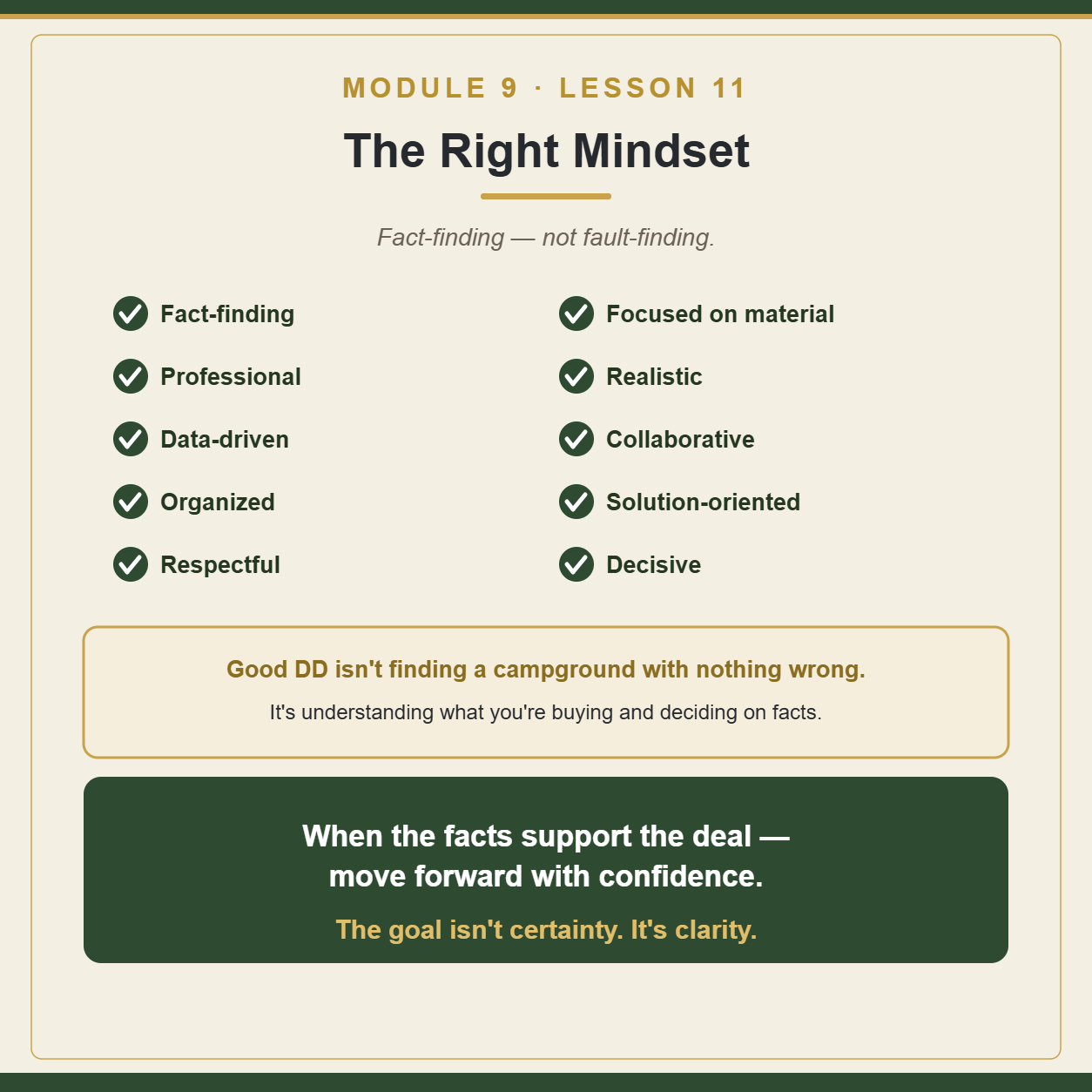
THE RIGHT DUE-DILIGENCE MINDSET
✓ Fact-finding — not fault-finding • ✓ Professional
✓ Data-driven • ✓ Organized • ✓ Respectful
✓ Focused on material issues • ✓ Realistic
✓ Collaborative • ✓ Solution-oriented • ✓ Decisive
LESSON TAKEAWAY
Good due diligence doesn’t mean finding a campground with nothing wrong. It means understanding what you’re buying, knowing the risks you’re accepting, and deciding based on facts. Ask the hard questions, use professionals, investigate what matters, stay organized — and when you have the answers you need, make the decision and move forward with confidence. The goal of due diligence is not certainty. It’s clarity.