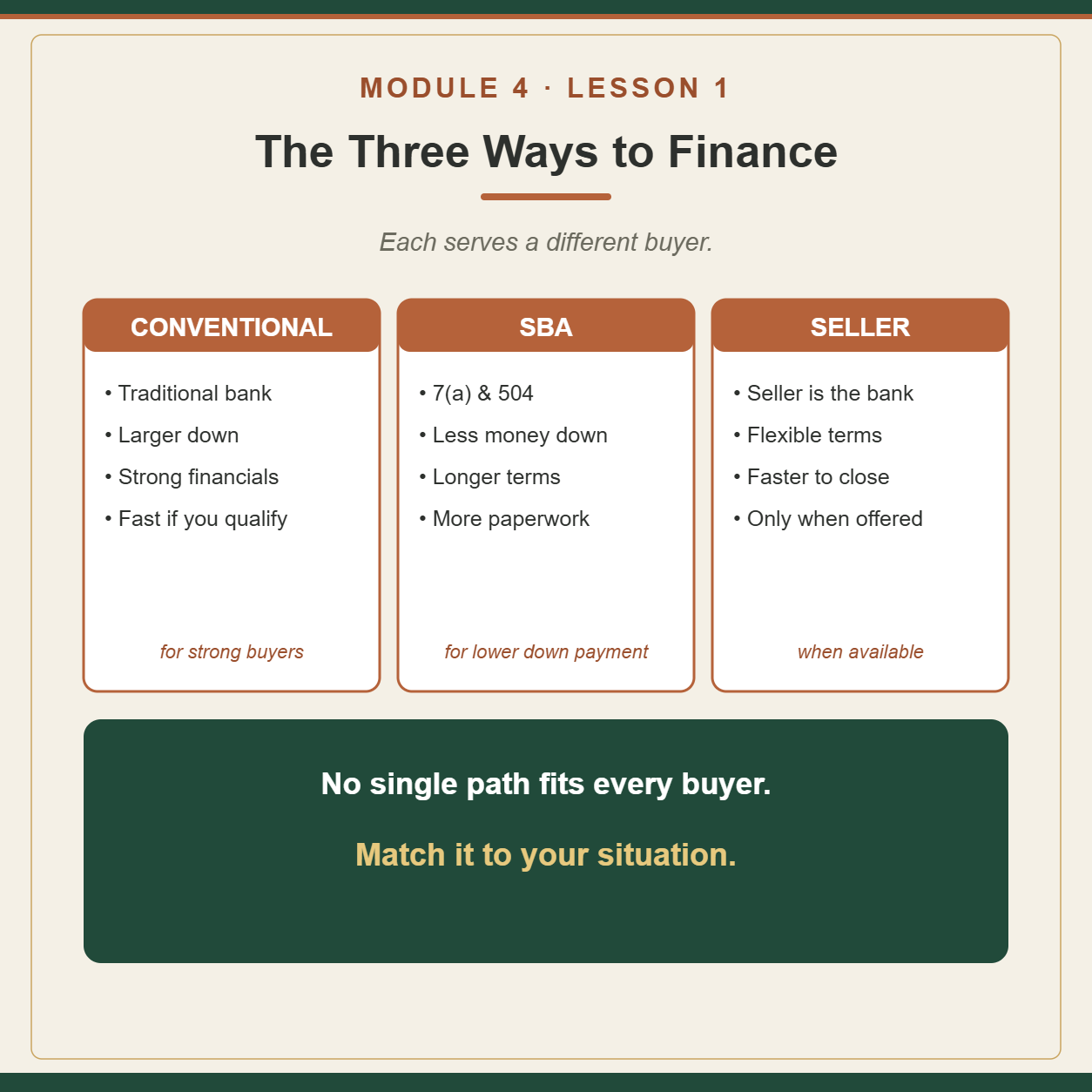
Most campground buyers will typically encounter three common financing structures.
Each works differently and each serves a different purpose.
No one option is automatically better than another.
The right financing structure depends on:
✔ your financial position
✔ liquidity available
✔ experience level
✔ risk tolerance
✔ the campground opportunity itself
✔ long-term ownership goals
1. Conventional / Commercial Financing (Most Common)
Traditional commercial financing used by banks and lenders.
Lenders commonly evaluate:
✔ Debt Service Coverage Ratio (DSCR)
✔ business cash flow
✔ borrower financial strength
✔ liquidity and reserves
✔ credit history
✔ operational experience
✔ property performance
Typically best for:
✔ stronger financials
✔ larger campground acquisitions
✔ experienced buyers
✔ stable operations
What is DSCR?
DSCR = Debt Service Coverage Ratio
Simply put:
“Does the campground generate enough income to comfortably support the loan payment?”
Example:
Campground cash flow: $200,000
Annual loan payment: $150,000
DSCR = 1.33
Most lenders generally prefer approximately 1.20–1.30+ or greater.
2. SBA Financing (Lower Down Payment Option)
SBA financing may allow buyers to purchase with less money down than conventional financing.
SBA financing commonly involves:
✔ lower down payment structures
✔ owner-operator requirements
✔ longer approval timelines
✔ more documentation
✔ stricter underwriting requirements
Things buyers should understand:
⚠️ Be cautious with floating interest rates
⚠️ Ask about future access to working capital
⚠️ Understand reserve requirements
⚠️ Understand how payment changes could affect cash flow
⚠️ Understand long-term ownership obligations
SBA can be an excellent tool when properly structured.
3. Seller Financing (when available)
Seller financing can create flexibility and may sometimes create opportunities that traditional lenders cannot.
Seller financing can sometimes help with:
✔ deal structure
✔ down payment assistance
✔flexible terms
✔ transition periods
Banks often like seeing a seller willing to carry back a small second position because it may demonstrate seller confidence in the business.
However:
⚠️ Sellers typically want their position secured
⚠️ Seller financing terms vary significantly
⚠️ Not all sellers are willing to participate
⚠️ Future working capital financing may require a lender wanting first position
Buyers Must Understand
Many lenders want buyers to have liquidity available beyond the down payment.
Buyers should ideally have approximately:
✔ down payment funds available
✔ reserve funds available
✔ working capital available
Owning a campground requires:
✔ business decisions
✔ operational planning
✔ common sense
✔ preparation for unexpected expenses
LESSON TAKEAWAY
The goal is not simply getting financing.
The goal is obtaining financing that supports the business long after closing.
The lowest down payment option is not always the best option.
Strong buyers focus on:
✔ affordability
✔ reserves
✔ long-term sustainability
✔ operational success
✔ realistic expectations
“The best financing structure is not necessarily the one with the lowest money down — it is the one that supports long-term success.”