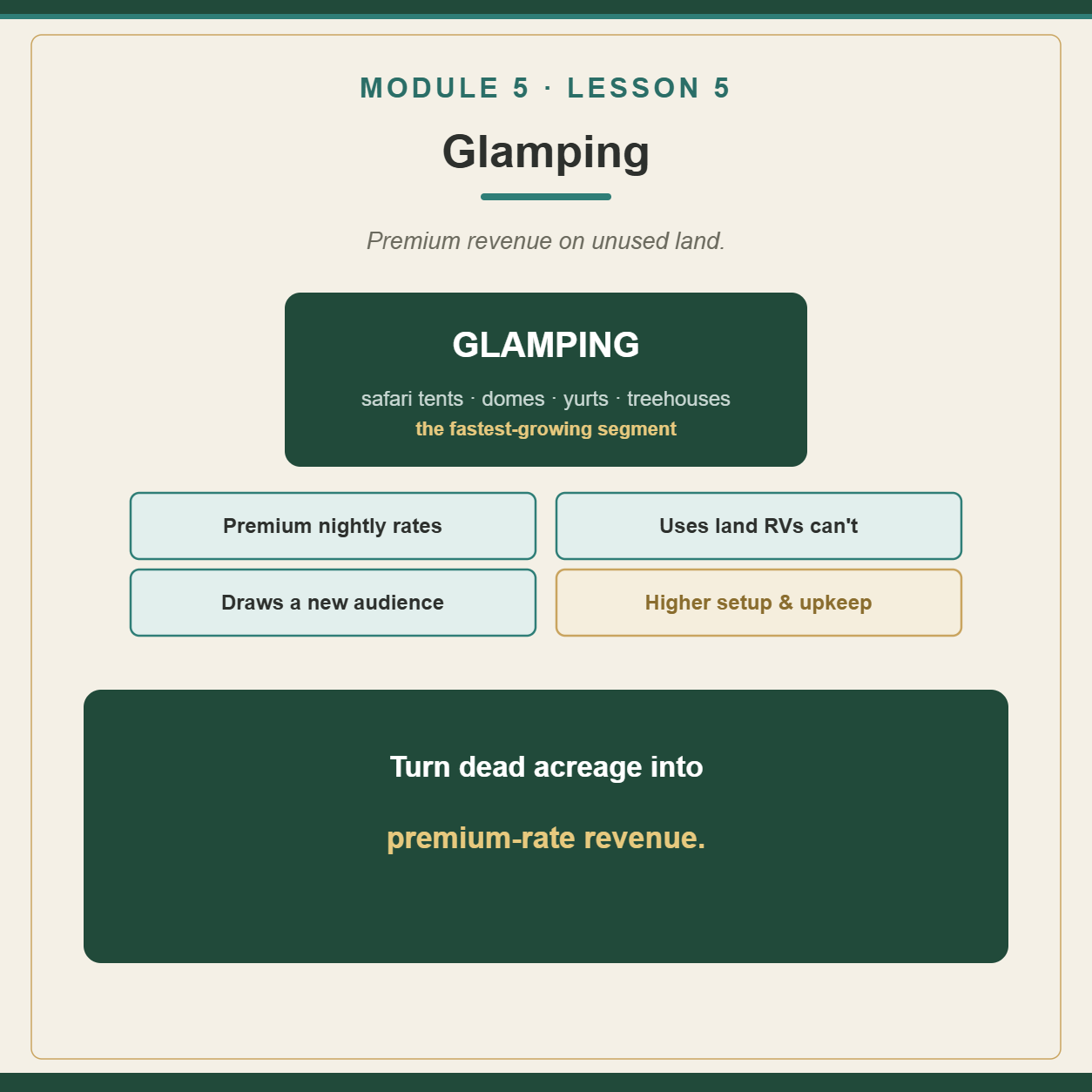
Glamping — luxury camping in safari tents, domes, yurts, and treehouses — is the fastest-growing segment in the industry (a $4 billion-plus market growing 10–12% a year). But the reason it matters to a buyer isn’t the trend. It’s what it does with your land.
Why It’s Booming
Here’s the demand driver most owners miss: a huge number of people want the outdoor experience but don’t want to spend thousands on tents, sleeping bags, gear, or an RV — and don’t want to learn how to set it all up. Glamping removes every barrier. The guest just shows up and enjoys the outdoors — no equipment, no learning curve. That’s why glamping pulls in people who would never otherwise camp: first-timers, families testing the waters, and younger travelers who’d rather spend on the experience than on equipment.
The Reframe: Sell the Land You Can’t Otherwise Use
Every park has ground that can’t hold an RV pad — the wooded back acreage, the steep hillside, the creek frontage, the scenic ridge. To an RV buyer, that land is worthless. To a glamper, it’s the whole point. A safari tent tucked in the trees or a dome with a view commands more per night than your best RV site, on land you couldn’t otherwise monetize. Glamping turns your toughest acre into your highest-earning one — which is exactly how it “uses more of your property.” And with the right construction — decks, platforms, even units on stilts — you can put glamping on terrain nothing else could use: a steep slope, a rocky patch, the edge of a pond, or ground that floods. Often the harder the land, the better the view — and the more a guest will pay to wake up to it.
A real example
There’s a glamping park in the northern U.S. running 20 glamping tents — no bathrooms, no kitchens in the units, just a shared common building for all of it. In their first two years they’ve grossed over $360,000. The quiet lesson in those numbers: keeping the plumbing out of the tents made each unit cheap to build, and one shared bathhouse served all twenty. (Their season is short and weather-dependent — northern parks live and die by it — so results vary with location.)
What It Costs & How Fast It Pays Back
A basic glamping tent — furnished, no plumbing — runs roughly $5,000 to $15,000 (budget options even lower), while luxury safari tents and domes run $20,000–$50,000+. Add site prep and a shared bathhouse and you can stand up several units for the cost of one cabin. Across the industry, glamping setups typically pay back in two to four years (faster for low-cost tents).
But location, weather, and season are everything. The same tent that books 80 nights in a destination market might book 25 in a slow one. Run your market’s real numbers before you buy.
Glamping Is Whatever You Make It
There’s no single “glamping.” It runs from a bare safari tent with a shared bathhouse (cheap and scalable), to fully self-contained units with kitchens and baths (pricier, premium rates), to one-of-a-kind experiences — airstreams, converted grain silos, treehouses, covered wagons, even a restored rail car. The more unique and tied to your location it is, the more you can charge and the more it markets itself. You can turn almost anything — including a building or asset you already own — into a glamping site, which is one more way glamping helps you use more of your property.
The Catch: It’s Hospitality, Not Camping
Glamping is closer to running a boutique hotel than a campground. Budget for proper utilities and sanitation, permitting and building codes (a “tent” on a platform can trigger them), higher insurance, and hotel-level housekeeping between every stay. These costs are real — include them before you fall for the nightly rate.
Three Plays Most Owners Miss
1. It’s a marketing engine, not just lodging. One photogenic dome at sunset becomes the image that sells your entire park. Glamping guests post their stay — free advertising that drives bookings across every site type. Make your best unit the hero shot.
2. Test before you scale. Don’t build ten units on a hunch. Put up one or two, prove your market will pay the premium, then expand with confidence.
3. It acquires your highest-value customer. Glampers skew younger, higher-spending, and experience-driven — about a third of new campers are glampers. They book activities, spend at the store, and come back. You’re not just renting a tent; you’re capturing the guest who spends the most across the park.
“In fifty years I’ve watched owners walk right past their best opportunity — the land they figured was useless. The wooded corner, the slope, the spot by the creek that won’t take an RV. That’s exactly where glamping shines, and where guests will pay the most to be. Glamping lets a park earn real money on ground it was mowing for free. Just remember it’s a hotel, not a campsite — and your market has to have a reason to pay the premium.”
Lesson Takeaway
Glamping isn’t about chasing a trend. It’s about putting premium revenue on land you already own but can’t otherwise use — when your market has the draw to support it.
“Glamping doesn’t add sites. It turns your worst land into your best.”