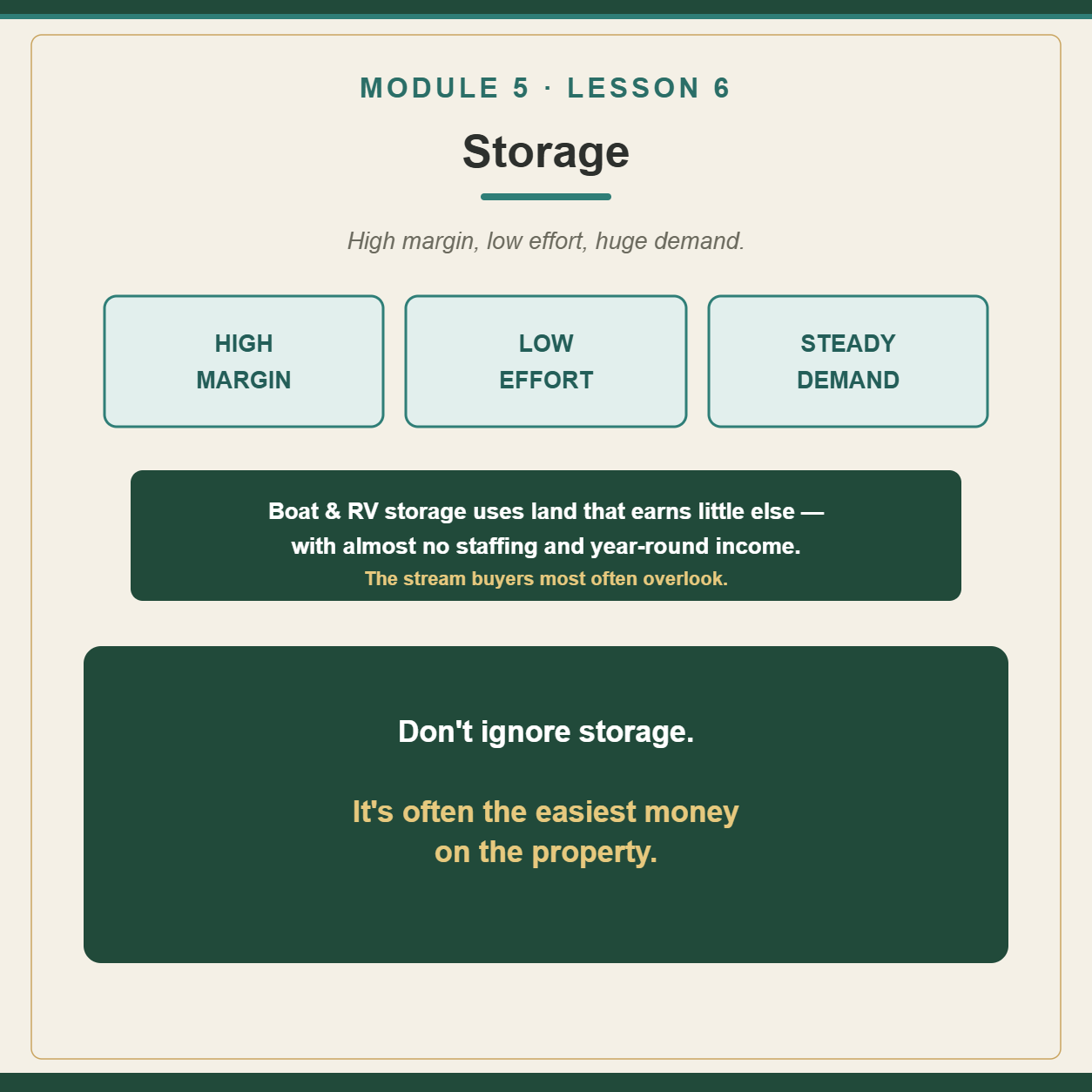
Of all the revenue streams in a campground, storage is the one buyers most often ignore — and it may be the smartest. It earns money on land you’re not using, in the season you’re not open, with almost no labor. And demand is exploding.
The Demand Story
RV and boat storage is one of the most undersupplied niches in real estate. There are roughly 1,800 dedicated RV/boat storage facilities in the country — for about 25 million RV- and boat-owning households. The market is growing around 10% a year (toward $40 billion), roughly three times faster than traditional self-storage, and rents keep climbing. People have toys and nowhere to put them — and a campground often already has the land, the location, and the gate.
Why Storage Is the Highest-ROI Stream
- Near-pure margin — no utilities, no cleaning, no turnover, minimal staff.
- Recurring and predictable — customers pay monthly or annually and rarely leave. The most bankable income on the books (and lenders love it).
- Monetizes dead land — the back field or unused acreage that can’t take a campsite.
- Monetizes the dead season — it’s the only stream that earns in January. Winter income for almost nothing.
The double-dip most owners never make
Your seasonal campers already leave their rigs on-site all year. Charge them a storage fee for the off-season. They save the cost and hassle of hauling their camper to an outside lot every fall and back every spring — and you earn extra income off the very same pad once the season ends. You get paid twice for one site, and the customer is grateful for the convenience.
Beyond Your Guests — the Whole Town Is a Customer
You’re not limited to campers. Boats, RVs, trailers, jet skis — locals need somewhere to put them, and many HOAs and cities ban parking them at home. Your gravel lot can serve the entire community, not just your guests.
Start Simple, Scale Up
A fenced, gated gravel lot is the entry point — low capital, fast return. From there you can add covered storage, then enclosed or climate-controlled units that earn multiples of an open lot. You can even bundle services — winterizing, prep, wash, battery tending — turning storage into a service-revenue doorway. Done well, storage can add $20,000 to $150,000+ a year depending on your land.
The Catch
Storage uses land, so weigh it against higher-value uses on prime ground — though it shines on land you can’t otherwise use. It needs fencing and security, and may require permitting or zoning approval. The returns are steady rather than explosive — but they’re about as close to free money as this business offers.
“I’ve told buyers the same thing for years: storage is where it’s at, and hardly anybody’s doing it. Your seasonal folks leave their campers on your land all winter anyway — charge them to store it and you’ve saved them a tow and made yourself money on an empty pad. Add boat and RV storage for the locals, and you’ve got income coming in the dead of January, when the gates are closed. It’s about the closest thing to free money this business has.”
Lesson Takeaway
Storage won’t make headlines, but it may be the highest-margin, lowest-effort money in the whole park — and it earns when nothing else does. If a park has spare land, storage is almost always your next $50,000.
“Storage turns empty land and a closed season into a paycheck.”