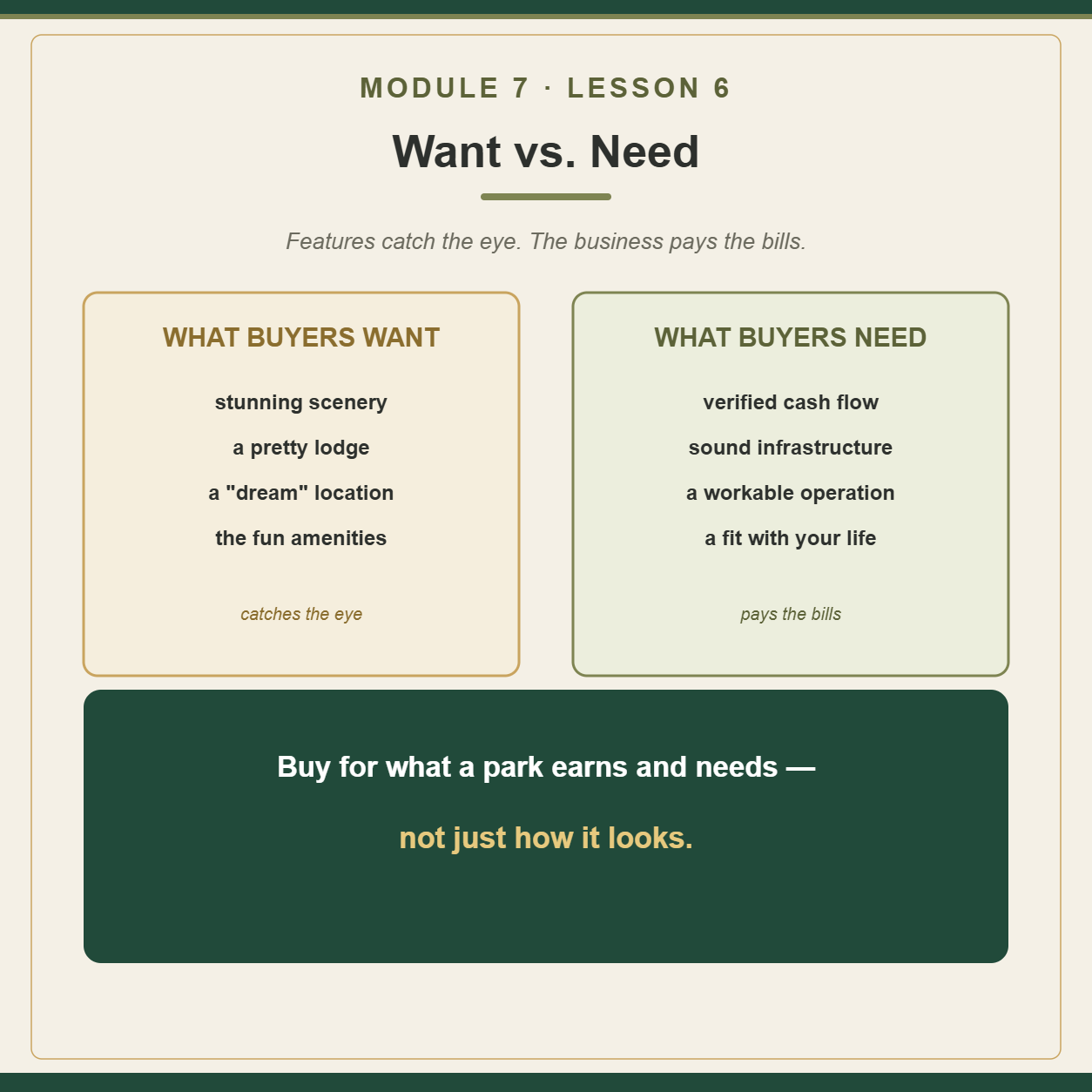
FEATURES CATCH THE EYE. THE BUSINESS PAYS THE BILLS.
One of the most valuable things you’ll learn while buying a campground is the difference between what catches your eye and what actually supports your long-term success. New buyers begin their search focused on features. Experienced buyers focus on the business. Half of what we do every day is help good people realize they don’t actually want the park they walked in asking for.
So before you fall for a listing, separate what you say you want from what you’ll really be glad you bought.
EVERY FEATURE IS ALSO A JOB
Here’s the honest translation — because almost every “dream park” feature is also a business you’ll have to run:
| The feature | The business behind it |
|---|---|
| “A big, busy park” | More sites mean more staff, more payroll, more problems to manage. You become a boss and an administrator — not a host by the campfire. Busy isn’t the same as restful, or profitable. |
| “Waterfront” | A premium price up front, plus docks, shoreline permits, water-quality rules, and added liability. Gorgeous — and a permanent regulatory project. |
| “A pool and amenities” | A pool is chemicals, staffing, and insurance. Every jumping pillow, rec hall, and mini-golf course is one more thing to maintain, insure, and staff. |
| “Cabins and a store” | Cabins are a little hotel — housekeeping, turnovers, bookings. A store is a little shop — inventory, hours, shrinkage. Two more businesses bolted onto the campground. |
| “Expansion potential” | Years of permitting, engineering, and capital before one new site earns a dollar. Potential is a bill long before it’s a return. |
A clean 40-site park with full hookups and a quiet office can out-earn — per headache — a 150-site resort with a pool, a store, cabins, and a grill. Busy parks photograph well. Simple parks often live well.
ASK A DIFFERENT QUESTION
Instead of asking “What looks exciting?” ask “What can I successfully own, operate, and improve?” Those are very often two completely different campgrounds.
BIGGER ISN’T ALWAYS BETTER
A 40-site campground with excellent financials, loyal guests, updated infrastructure, and manageable operations may deliver a better lifestyle and stronger returns than a 150-site resort that demands dozens of employees, carries major deferred maintenance, and needs constant oversight. Don’t confuse size with success.
BUY FOR THE NEXT 10 YEARS — NOT THE NEXT 10 MINUTES
It’s easy to fall in love on a property tour: beautiful views, a full park, happy campers, a buzzing holiday weekend. But ask yourself whether you’ll still enjoy owning it…
- during the quiet off-season?
- after a water line breaks at 11 p.m.?
- the week payroll is due and the weather turned?
- ten years from now?
Think past the first impression.
THE BEST BUYERS SHIFT THEIR THINKING
Instead of “I want the biggest campground,” they start asking the questions this whole module is built on:
- Which campground fits my lifestyle?
- Which campground matches my experience?
- Which campground fits my budget?
- Which campground gives me the greatest chance of success?
That’s when smart buying begins.
STOP CHASING FEATURES. START CHASING FIT.
If you remember one thing from this entire module, make it this table. It’s fifty years of hard-won advice in seven lines:
| Buyers think they want… | Successful owners look for… | |
|---|---|---|
| A bigger park | → | Better cash flow |
| More sites | → | Higher occupancy |
| More amenities | → | Better ROI |
| Waterfront | → | Stable infrastructure |
| The cheapest deal | → | Best long-term value |
| Fast growth | → | Sustainable growth |
| A “dream park” | → | A right-fit park |
“Whether that big, amenity-rich, room-to-grow park is a dream or a trap comes down to two things: working capital and age. Working capital, because the bigger and busier the place, the more cash it eats before the season ever pays you back — payroll, a broken well, a slow June. And age, because hands-on years are finite. A buyer at forty and a buyer at sixty-five should not be looking at the same park, no matter how pretty it photographs. Be honest about how much cash you can carry and how many hard years you’ve got in you, and the right size of park picks itself.”
The best campground isn’t the one with the most amenities. It’s the one you’ll enjoy owning, successfully operating, and confidently growing.
The goal isn’t to buy the campground that impresses everyone else — it’s to buy the one that’s right for you.
Buy the business you’ll still love after the excitement of closing wears off.