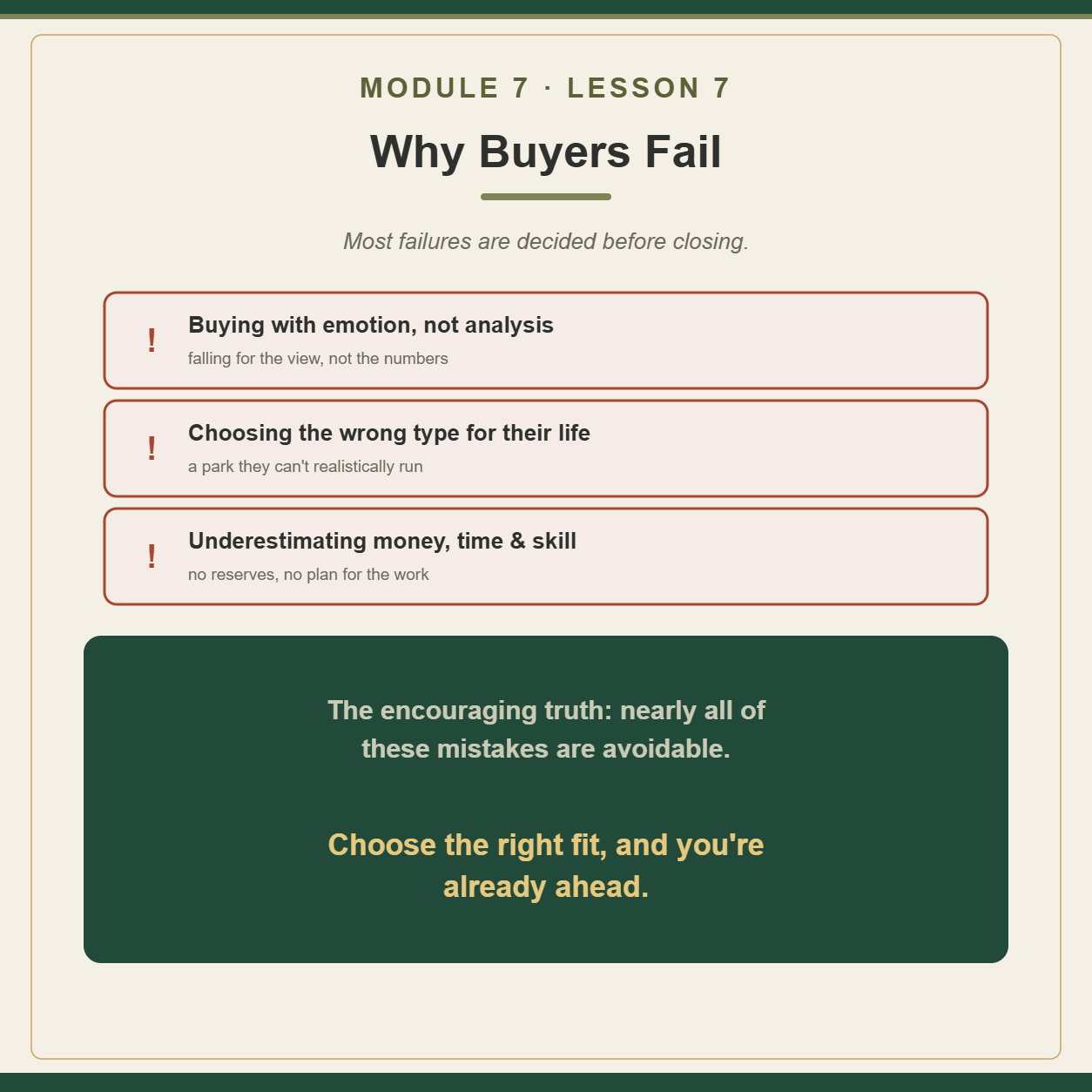
MOST FAILURES ARE DECIDED BEFORE CLOSING
Here’s the encouraging truth hidden inside a hard subject: most buyer failures aren’t bad luck. They’re mismatches — decisions made before the keys ever changed hands. Which means almost every one of them is avoidable, and you’ve spent this entire module learning how.
Failure in this business is rarely a dramatic crash. It’s usually a slow leak: a little more work than expected, a little less cash than needed, a few too many quiet weeks — until the energy and the money both run out. So let’s name the leaks, and plug them.
THE REAL REASONS BUYERS FAIL
Nearly every first-year failure traces back to one of these — and every one has a defense:
| Why buyers fail | How you avoid it |
|---|---|
| They buy the wrong type of park. | Match the park to your lifestyle, experience, and budget first — exactly what this module walked you through. Fit comes before everything. |
| They buy too big, too fast. | Start with a park you can actually run today and grow into bigger later. Your first park is a school, not a monument. |
| They misread the workload. | Understand the real daily and seasonal work before you sign. Talk to current owners, not just the broker, and picture your ordinary Tuesday. |
| They have no management experience. | Buy simpler, hire for the gaps, or cut your teeth on a smaller park first. Experience is capital — spend it wisely. |
| They run out of cash in the off-season. | Model the lean months and keep a working-capital reserve. Seasonal income with year-round bills is what sinks the under-funded. |
| They inherit utility and infrastructure problems. | Inspect the wells, septic, electrical, and roads hard. A cheap-looking park with a failing septic was never cheap. |
| They over-build — too many amenities, cabins, and staff. | Remember every amenity is its own business. A few well-run profit centers beat a dozen half-run ones. |
| They’re under-capitalized from day one. | Don’t spend your last dollar at closing. The park will ask for more — have it ready before it does. |
THE PATTERN BEHIND ALL OF THEM
Look closely and almost every failure on that list comes down to the same two things: a mismatch between the buyer and the park, or running out of cash or energy before the park pays off. Fit, working capital, and an honest read on your own stage of life — protect those three, and you’ve protected yourself from most of this list.
- You’re buying because it’s a “good deal,” not because it fits you.
- You haven’t seriously thought about the off-season.
- You have little or no cash cushion after the down payment.
- You’re quietly telling yourself, “I’ll figure it out.”
- You fell in love on a sunny holiday-weekend tour.
- Buy for fit, not features.
- Keep a working-capital cushion — always.
- Start simpler than you think you need to.
- Verify every utility and system before closing.
- Model the slow months, not the busy ones.
- Be honest about your stage of life and your energy.
“In all my years I’ve almost never had a buyer sit across from me and think they’d be the one who doesn’t make it. Everybody’s sure failure is the other fellow’s problem. But I’ll tell you straight — this life isn’t cut out for everyone, and there’s no shame in that. The buyers who do well aren’t the boldest or the richest. They’re the ones honest enough to ask, ‘Is this really me?’ — and brave enough to walk away when the answer is no.”
This lesson isn’t here to scare you off — it’s here so you walk in clear-eyed. The buyers who thrive took this list seriously, bought the park that fit them, kept cash in reserve, and were honest about the work. Do that, and you don’t just avoid failing — you set yourself up to genuinely love what you own.