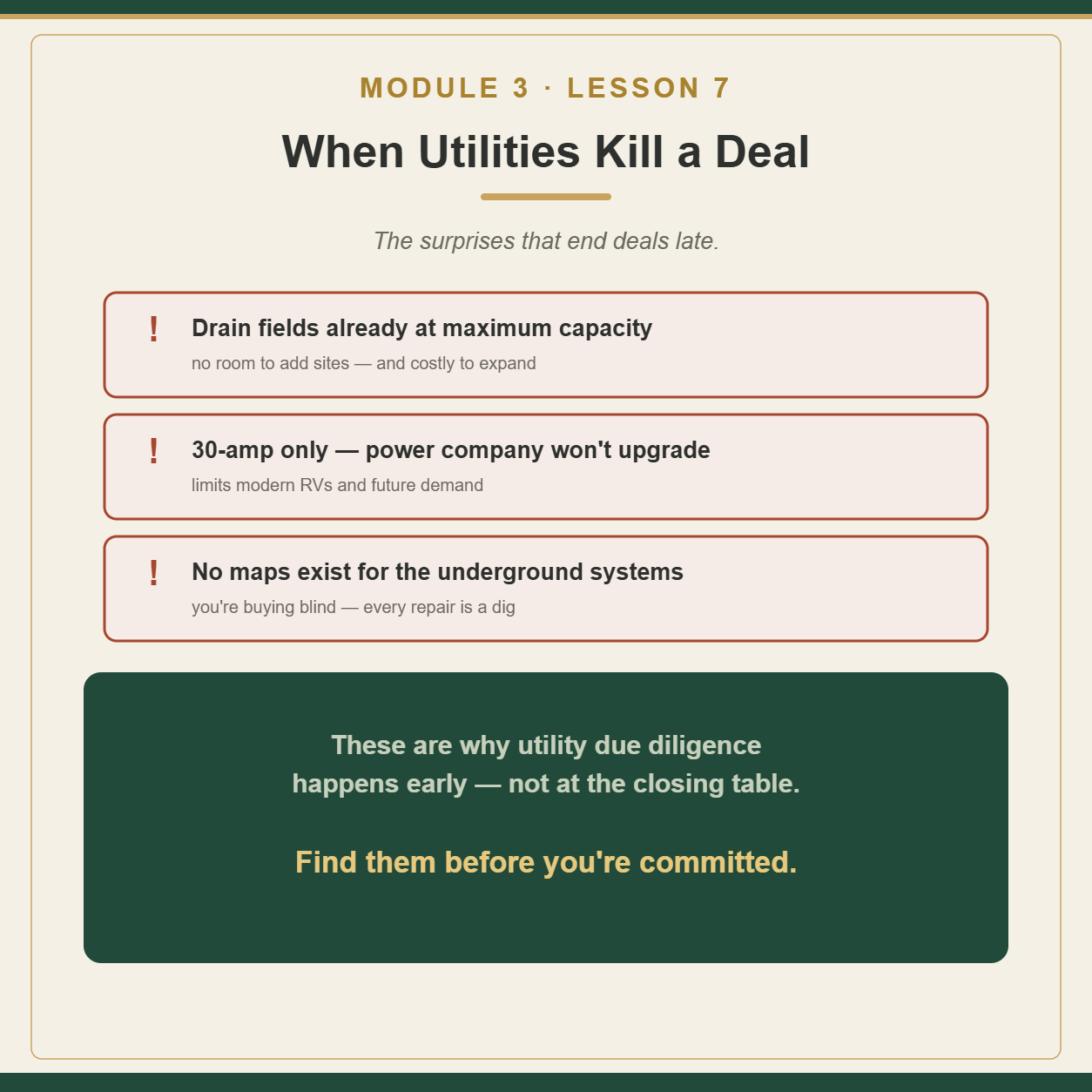
Deals commonly fall apart when buyers discover issues they never expected.
Examples:
❗ Drain fields are already at maximum capacity
❗ Park is 30 amp only and the power company will not support upgrades
❗ No maps exist for water, sewer, or electrical systems
❗ Unpermitted sites or undocumented expansions exist
❗ Well systems do not meet current state testing requirements
❗ Lagoon systems do not meet state or EPA requirements
❗ Infrastructure does not support future expansion
Buyers should also understand:
The local health department is often one of the quietest and most valuable places to investigate a campground.
They may have records involving:
✔ prior inspections
✔ permits
✔ water system history
✔ septic records
✔ violations
✔ complaints
✔ licensing history
✔ expansion approvals
Many states have strict campground licensing requirements and construction standards.
Another issue buyers often overlook:
Inspections and approvals frequently happen very late in the transaction.
In some cases:
- Closing is approaching
- Inspection reports arrive
- Repairs are required
- But there may not be enough time left before closing to complete the work.
- The clock can run out quickly.
Buyers must understand:
It is not about what looks pretty.
It is about what is:
✔ functional
✔ compliant
✔ financeable
✔ sustainable
LESSON TAKEAWAY
Campgrounds do not usually fail because of what buyers can see.
Deals often fail because of what buyers never investigate.
Strong buyers learn to look beyond:
✔ beautiful views
✔ cabins
✔ lakes
✔ amenities
✔ aerial photos
and focus on:
✔ infrastructure
✔ compliance
✔ licensing
✔ utility capacity
✔ documentation
✔ long-term functionality
The goal is not finding a perfect campground.
The goal is identifying problems before they become expensive surprises.
“Pretty creates interest. Functional and financeable gets the deal closed.”