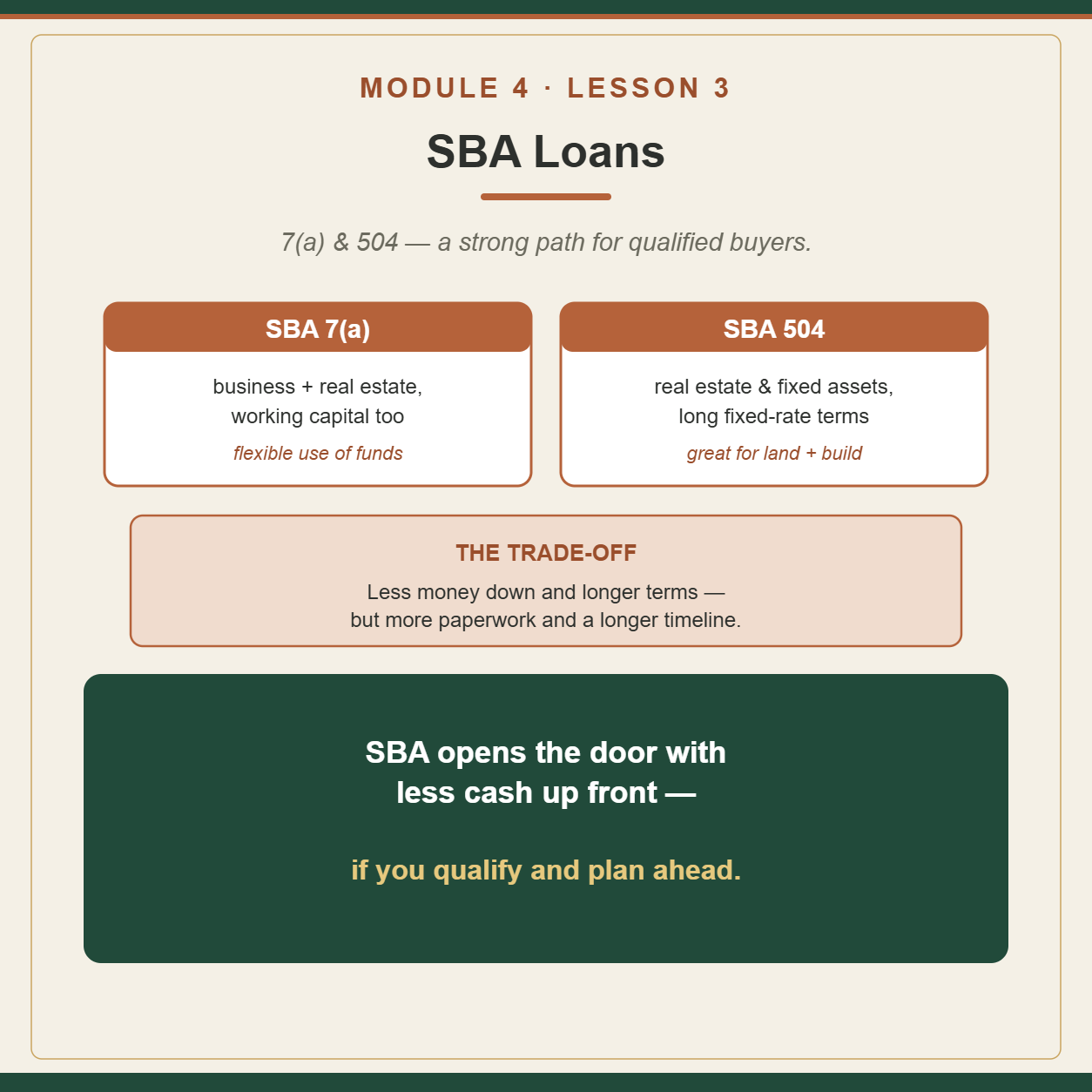
SBA financing can be an excellent option for buyers who qualify. It often allows buyers to purchase a campground with less money down than conventional commercial financing — but lower down payments also come with greater lender scrutiny.
7(a) vs. 504: What’s the Difference?
The SBA offers two programs, and buyers mix them up constantly:
- SBA 7(a) — the flexible workhorse. Up to $5 million, usable for the business and the real estate together, usually a variable rate, with terms up to 25 years on real estate. Best when you want one loan to cover everything.
- SBA 504 — built for the real estate and fixed assets. A bank covers part, a CDC (Certified Development Company) covers part, and you can put down as little as 10%. Fixed rate, with 10-, 20-, or 25-year terms. Best when the deal is mostly land and buildings.
Rule of thumb: 7(a) for flexibility, 504 for buying the dirt and buildings at a low fixed rate.
Common SBA Requirements
- ✔ 10–20% down payment (varies by lender and transaction)
- ✔ Buyer must actively operate the business
- ✔ Strong personal credit history
- ✔ Personal financial statement
- ✔ Personal guarantees
- ✔ Clean seller financials
- ✔ Business management or related experience
- ✔ More documentation and underwriting
- ✔ Higher loan fees
- ✔ Longer approval timelines
- ✔ Working capital available after closing
SBA Works Best For
- ✔ Owner-operators
- ✔ Buyers with strong employment or management backgrounds
- ✔ Campgrounds with clean financial records
- ✔ Buyers who have sufficient reserves in addition to the down payment
- ✔ Buyers looking for long-term ownership
SBA Can Become More Challenging When
- ⚠️ Buyers want to be absentee owners
- ⚠️ Financial records are incomplete or inaccurate
- ⚠️ Personal expenses are heavily mixed into the business
- ⚠️ Significant deferred maintenance exists
- ⚠️ Major utility or infrastructure issues require immediate capital
- ⚠️ The buyer has limited reserves after closing
- ⚠️ The campground requires a substantial operational turnaround
Three SBA Rules That Catch Buyers Off Guard
1. The 50% Rule. At least half the park’s gross revenue must come from short-term stays (30 days or less). If more than 50% comes from seasonal or long-term campers, the SBA treats the park like residential rental property and won’t finance it. A blended mix — transient travelers plus some monthly guests — is actually the strongest position.
2. Seller Financing Goes on “Full Standby.” If the seller carries back part of the price and that note counts toward your down payment, the SBA now requires it on full standby — no payments, principal or interest — for the entire life of the loan (often 10 years). This changed June 1, 2025; it used to be just two years.
3. No Leased Land. If the campground sits on leased or ground-leased land, SBA financing gets very hard. The lease has to outlast the loan, and leased land carries little collateral value. If you don’t own the dirt, treat SBA as a long shot.
“Here’s where I’ve watched deals fall apart. If a seller agrees to carry back part of the price and it counts toward your down payment, the SBA wants that note on full standby — the seller collects nothing, not principal, not interest, until the whole loan is paid off. Now picture telling a seller who just gave you a break on price that he also has to wait ten years to see a dime. Most won’t do it. Know that before you sit down at the table, and structure the deal so the carry-back works for both sides.”
Common Buyer Mistakes
- ❗ Spending every available dollar on the down payment
- ❗ Not budgeting for working capital
- ❗ Underestimating operating expenses during the first year
- ❗ Assuming the SBA process is quick
- ❗ Focusing only on qualifying instead of long-term affordability
Lesson Takeaway
SBA financing can create opportunities that might not otherwise be possible. But remember: lower money down does not mean lower risk.
The strongest SBA borrowers are financially prepared before closing — and financially stable after closing.
“The goal isn’t just getting the loan — it’s having enough cash left to successfully operate the campground.”