UTILITIES ARE USUALLY THE REAL LIMITER
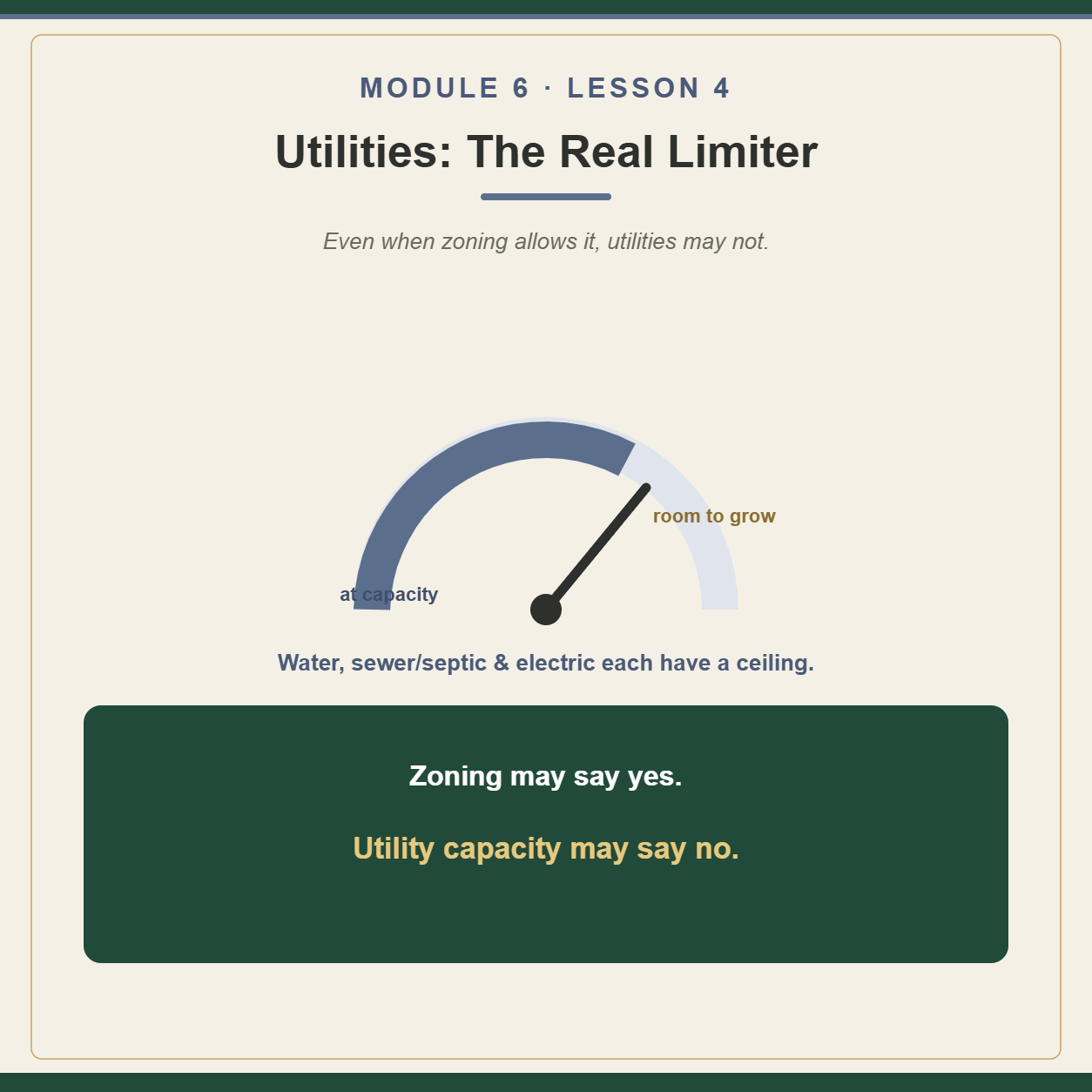
Even if the zoning allows expansion, and even if the seller swears there’s room — utilities are usually the showstopper. Here’s the reframe most buyers miss: every utility has a hard capacity number. The well has a permitted yield, the septic has a permitted design flow, the electrical service has an amperage. The real expansion question isn’t how many acres you have — it’s the gap between permitted capacity and what’s already being used. That gap is your headroom, or your wall.
WATER
A well is only permitted to produce so many gallons. Add sites and you may need:
- Adequate pressure
- Adequate flow
- New lines
- Possibly a second well
- Booster stations
- Storage tanks
If the park is near its permitted yield today, more sites mean a second well or a public connection — not just more pipe.
SEWER
This is the big one. Most septic systems cannot support new sites. To expand, buyers may need:
- A larger absorption field
- A new drain field
- Pump-station upgrades
- A city sewer tap (if one is even available)
- A wastewater treatment plant
These projects run from the low tens of thousands for an expanded drain field into six figures — and a full engineered treatment plant can reach the hundreds of thousands or more.
Add enough sites and you cross a daily-flow threshold that pulls in the state environmental agency and forces you off a simple septic system onto an engineered wastewater treatment plant. That one jump is the most expensive surprise in campground expansion — and the existing system may already be near its limit. Find out the permitted design flow, and how close the park already runs to it, before you count a single new site.
ELECTRICAL
A major factor, and an easy one to underestimate. More sites require:
- Additional transformers
- New service upgrades
- New pedestals
- Rewiring
- Coordination with the utility provider
Today’s guests expect 50-amp service; older parks wired for 30-amp may need a full service upgrade just to stay competitive — let alone grow. And the power company controls both the cost and the timeline.
GET THE NUMBERS BEFORE YOU PAY FOR POTENTIAL
You cannot eyeball capacity. Before you bank on expansion, get the three numbers — and have an engineer confirm them:
- The well’s permitted yield, plus a recent flow and water-quality test
- The septic’s permitted design flow, plus a recent inspection and pump-down
- The electrical service rating, plus a written “will-serve” letter from the power company on added capacity and cost
The gap between permitted capacity and current use is your real expansion headroom. Make any expansion-dependent value contingent on an engineer’s capacity opinion.
THE VALUE FLIP
Utilities cut both ways. A park with oversized infrastructure already installed — a treatment plant rated well above its current sites, three-phase power, a high-yield well — is handing you expensive capacity someone else paid for. That’s real, hidden value. A park overdue for a forced upgrade — an aging septic, a regulator’s notice — is a landmine. Price it in, or walk.
Land doesn’t expand a campground — capacity does. Get the well, septic, and electrical numbers, have an engineer confirm them, and never count a new site your utilities can’t actually serve.
“Utilities are where dreams meet the dirt. You cannot eyeball a well or a drain field — hire a good engineering firm and let them tell you the truth before you pay for potential. And plan ahead: engineer the whole build-out now, even if you build it in phases, so you size the water, power, and wastewater once instead of tearing it all up in three years. The cheapest infrastructure is the kind you only build one time.”