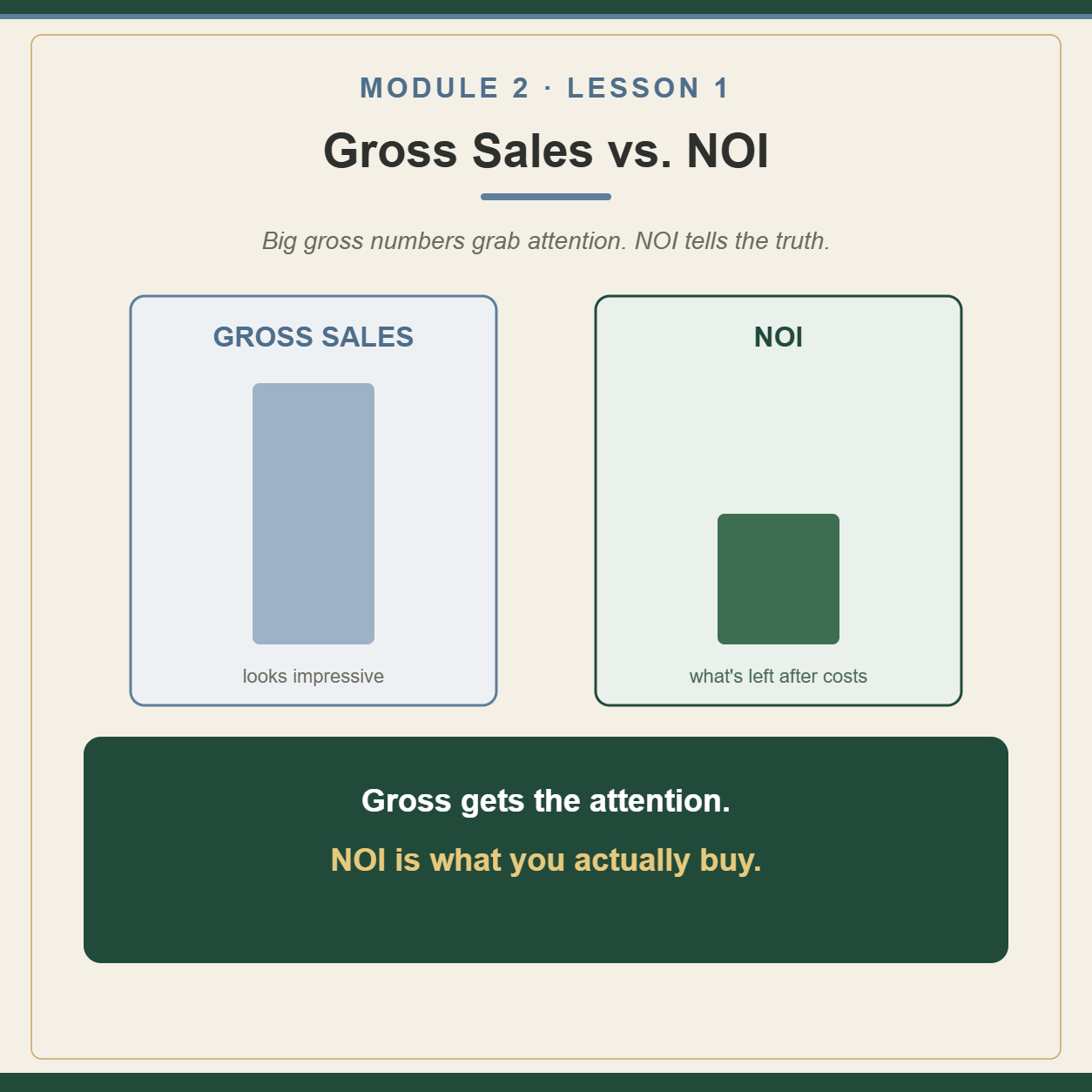
Many buyers get excited when they see big gross income numbers.
Example:
“This park grosses $800,000!”
But gross revenue alone does not tell the full story.
Without understanding:
- Expenses
- Labor
- Debt service
- Seasonality
- Owner perks
- Utilities
- Maintenance
- Taxes
- Add-backs
…you cannot understand the true performance of the buiness.
✔ NOI (Net Operating Income) is what matters.
NOI = Gross Revenue – Operating Expenses (before debt, depreciation, interest, taxes)
This is the number EVERYTHING is built around:
- Park value
- Bank financing
- Buyer expectations
- Price justification
❗Rule for buyers:
Never evaluate a campground based on gross revenue alone.
Some parks gross $1M and net $150K.
Some gross $300K and net $200K.
NOI tells the real story.
Understanding Revenue Sources & Profit Margins
One of the biggest mistakes buyers make is assuming all campground revenue carries the same profit margin.
It does not.
Different revenue streams produce very different operating costs and profitability.
For example:
Higher-Margin Revenue Sources
These often produce stronger profit margins with lower operational overhead:
- RV site rentals
- Tent camping
- Cabin rentals (depending on staffing)
- Camp stores / retail items
- Storage income
Camp stores, in particular, can produce strong margins on certain products and convenience items.
Lower-Margin Revenue Sources
Some revenue categories generate large gross sales numbers but carry significantly higher operating costs.
Examples include:
- Fuel sales / propane
- Restaurants and food operations
- Entertainment attractions
- Large event operations
- Labor-intensive amenities
These may increase gross revenue substantially while contributing less net income than buyers expect.
A park can appear very large on paper while producing thinner actual profit margins.
Every Campground Has a Different Financial Story
No two campground financial statements look exactly the same.
Financial performance can vary dramatically depending on:
- Geographic location
- Climate and season length
- Weather conditions
- Staffing availability
- Utility costs
- Local tourism demand
- Owner management style
- Amenity mix
- Type of guests served
A rainy season, drought, wildfire smoke, hurricanes, flooding, fuel prices, or regional economic changes can all impact campground performance from year to year.
This is why experienced buyers look beyond a single “good year” and focus on long-term operating patterns and realistic operating costs.
The Real Question Buyers Should Ask
The goal is not simply:
“How much does this park gross?”
The real question is:
✔ What does this campground realistically cost to operate?
Because ultimately:
Cash flow — not gross revenue — determines value.
LESSON TAKEAWAY
Gross revenue may attract attention, but NOI reveals the true financial performance of a campground.
Two parks with similar gross sales can produce completely different profits depending on:
- operating structure
- labor
- utilities
- amenities
- maintenance
- and management style
Strong buyers learn to look beyond surface numbers and focus on what the business actually produces after real operating costs.
Understanding NOI is the foundation for evaluating campground value correctly.
“Every campground tells a story. NOI tells the truth.”