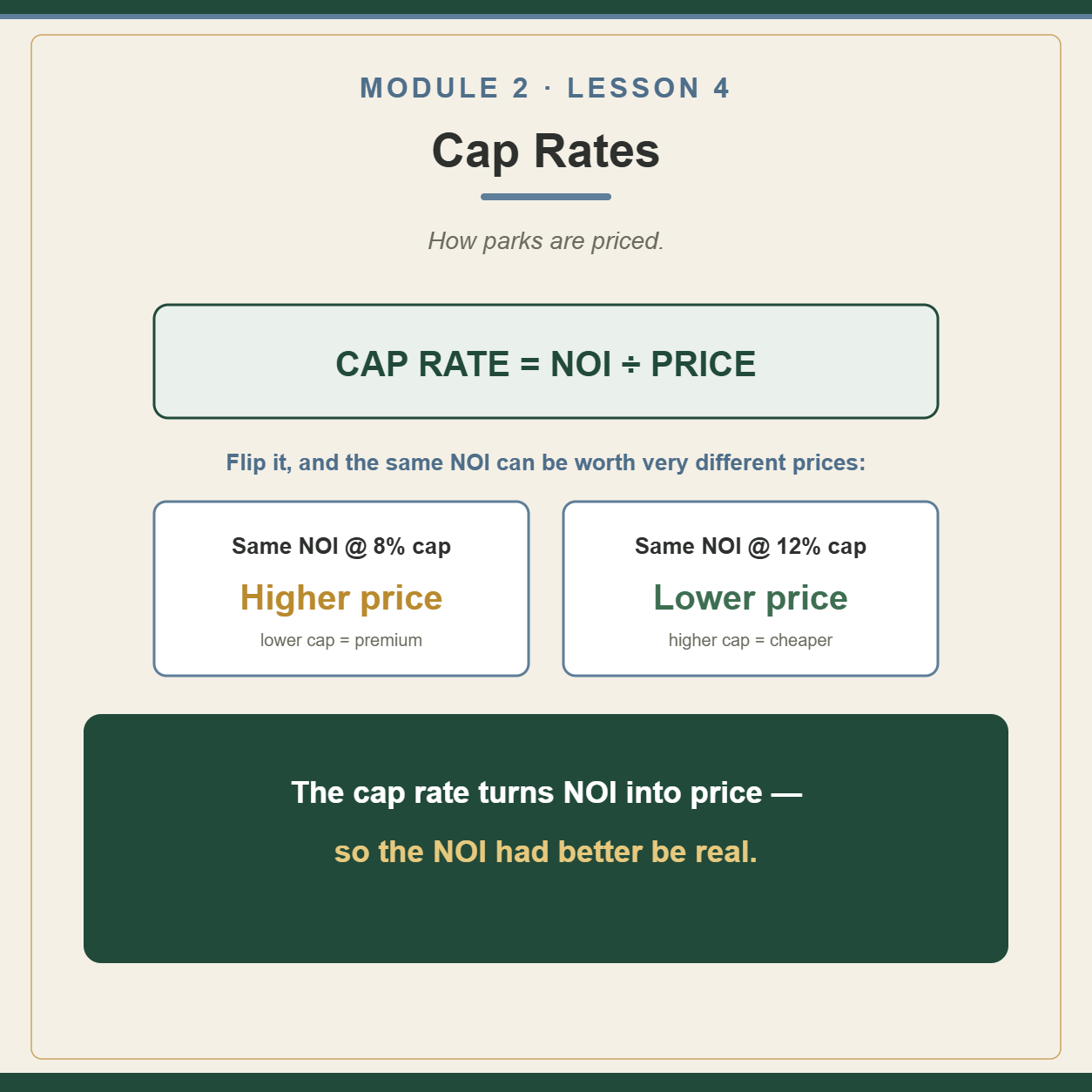
Buyers often misunderstand cap rates.
A cap rate is simply:
CAP RATE = NOI ÷ PURCHASE PRICE
Examples:
- A $100,000 NOI at an 8% cap = $1,250,000 value
- A $100,000 NOI at a 10% cap = $1,000,000 value
❗Important:
The lower the cap rate, the HIGHER the value.
Why?
Because buyers perceive the asset as:
- lower risk
- more stable
- more desirable
- or having stronger long-term demand
Typical campground cap rate ranges:
While cap rates can vary significantly, general campground market ranges often fall between:
- 6–7% → Premium or trophy assets
- 7–8% → High-demand parks
- 8–9% → Standard
- 9–10%+ → Rural / value-add parks
However, buyers must understand:
No two campgrounds are exactly alike.
This is why experienced campground valuation goes far beyond simple multipliers or generic formulas.
The adjusted NOI and the overall quality of the opportunity ultimately help determine market value.
Why campground valuation is different:
Campground and resort valuation is influenced by many factors, including:
- Location
- Business condition
- Property condition
- Utility infrastructure
- Historical performance
- Expansion potential
- Market demand
- Operational complexity
- Risk perception
Unlike many traditional real estate assets, campgrounds are operational businesses tied closely to hospitality, tourism, guest experience, and changing travel trends.
What Impacts Cap Rates?
Cap rates are influenced by many factors, including:
- Trailing 12-month performance
- Market demand
- Park condition
- Utility infrastructure
- Geographic region
- Expansion potential
- Historical financial performance
- Risk perception
Lower cap rates are typically associated with:
- stronger demand
- lower perceived risk
- better infrastructure
- and more stable operations
Higher cap rates are often associated with:
- operational uncertainty
- deferred maintenance
- rural locations
- turnaround opportunities
- or higher perceived risk
Campgrounds Are Different Than Traditional Commercial Real Estate
Many investor buyers initially analyze campgrounds the same way they would:
- apartment buildings
- office buildings
- warehouses
- or other stabilized commercial assets
However, campground and resort properties are often much more operational, seasonal, experience-driven, and fluid than traditional commercial real estate.
Unlike many commercial buildings with long-term leases and predictable income streams, campground performance can shift quickly based on:
- tourism trends
- weather
- guest experience
- management style
- amenities
- branding
- and operational execution
This is one reason campground valuation can vary significantly from more traditional real estate asset classes.
Two Different Ways Buyers Often View Campground Value
One of the biggest misunderstandings in the campground industry is assuming campground valuations work exactly like traditional commercial real estate.
In reality, campground and resort properties are often viewed in two very different ways.
Type One Thinking — Traditional Comparable Valuation
Some buyers evaluate campgrounds similarly to other commercial assets such as:
- apartment buildings
- office buildings
- warehouses
- or stabilized commercial properties
This approach focuses heavily on:
- historical financials
- stabilized NOI
- comparable sales
- current operational performance
- and traditional cap rate analysis
In simple terms, buyers are primarily evaluating:
“What is this property worth today based on current numbers?”
This is often the more conservative and finance-driven approach.
Type Two Thinking — Vision & Future Potential
Other buyers evaluate campground and resort properties based far more on:
- future opportunity
- expansion potential
- repositioning
- branding
- glamping additions
- operational improvements
- guest experience
- and long-term vision
These buyers are not only purchasing:
- the current operation
- but also the future possibilities of the property
This mindset is much more common in:
- outdoor hospitality
- destination resorts
- experiential travel
- and modern campground development
In many cases, buyers are investing in:
what the campground could become — not simply what it is today.
Why This Matters
Unlike many traditional commercial assets, the outdoor hospitality industry is extremely fluid.
Campground performance can shift dramatically from year to year due to:
- weather
- tourism trends
- remote work trends
- fuel prices
- economic conditions
- social trends
- camping demand
- and changing customer expectations
Because of this, historical balance sheets alone do not always tell the full story.
Experienced buyers learn to evaluate both:
- current operational performance
- and future operational potential
when analyzing campground value.
LESSON TAKEAWAY
Cap rates are not just formulas — they reflect risk, opportunity, demand, buyer perception, and future potential.
The best campground buyers learn to evaluate:
- both the numbers today
- and the long-term potential of the property tomorrow
Understanding campground value requires more than spreadsheet math alone.
“Some buyers purchase campgrounds for what they are. Others purchase them for what they could become.”