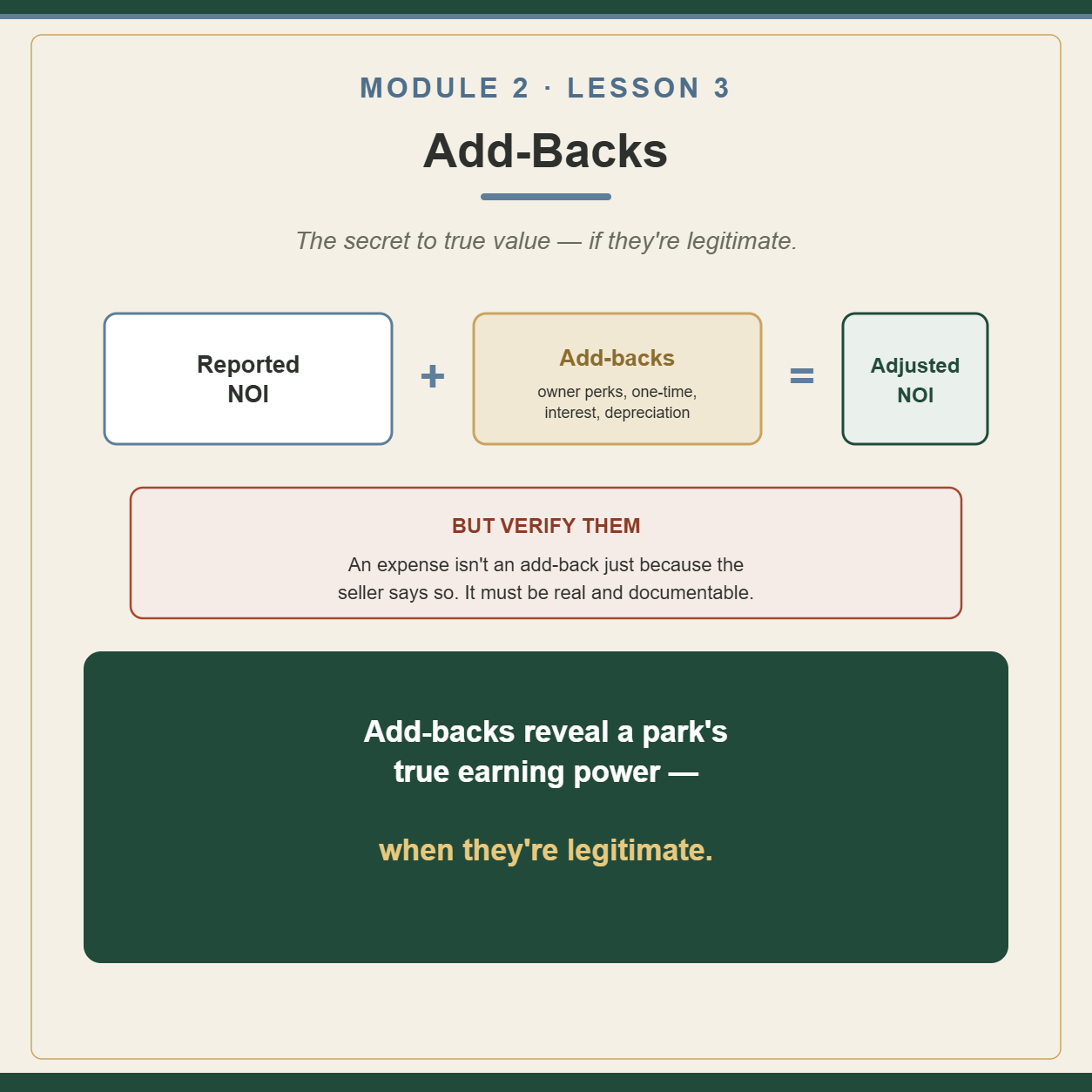
Many campground owners run certain personal or non-operational expenses through the business.
These are commonly referred to as add-backs.
Add-backs matter because they can increase the adjusted NOI of a campground and help buyers understand the business’s true earning potential.
Common add-backs:
- Owner salary (if not needed)
- Personal travel
- Personal vehicles
- Cell phones
- Family labor
- Depreciation
- Interest
- One-time repairs
- Insurance anomalies
- Utilities unrelated to park operations
Why Add-Backs Matter
Add-backs can make a campground appear either weaker or stronger than it truly is.
The goal is not to “inflate” the numbers — it is to understand the actual operating performance of the business once personal or non-recurring expenses are separated from normal operations.
This is one of the most important parts of campground valuation.
Owner Salary Add-Backs
One of the most common add-backs in campground transactions is owner salary.
In many privately owned campgrounds, the owner performs duties that may or may not require replacement after the sale.
Industry-standard practice often treats owner salary as a potential add-back when evaluating adjusted NOI.
However, buyers must understand:
If the buyer plans to hire management or additional staff to replace the owner’s role, some or all of that labor expense may need to be added back into the operating costs.
This is why:
- owner involvement
- staffing structure
- operational complexity
- and management style
…matter greatly when evaluating campground profitability.
A park operated by retired owners working full-time may perform very differently under absentee or investor ownership.
A Buyer’s Future Staffing Model Does Not Automatically Reduce Value
While buyers should carefully evaluate future staffing needs, it’s important to understand:
A seller is typically valuing the campground based on its current operating structure and historical financial performance.
If a buyer chooses to:
- hire additional management
- operate more passively
- reduce personal involvement
- or add staffing layers
…those future operational decisions do not automatically mean the seller should absorb those added costs through a reduced purchase price.
The campground may currently operate successfully with:
- owner involvement
- family labor
- or a lean staffing structure
That operating model still has real value in the marketplace.
A buyer’s future decision to increase staffing or operate the campground differently is considered a personal business choice — not necessarily a weakness in the existing operation.
The seller should not automatically be penalized because a future owner chooses a different management style, staffing structure, or level of involvement.
The value of the campground is generally based on:
- how the business currently performs
- how it has historically operated
- and what the market is willing to pay for that existing cash flow.
Different buyers also operate campgrounds differently.
An owner-operator buyer may choose to work the business directly and maximize cash flow, while an investor or absentee owner may prefer hiring staff and accepting lower returns in exchange for less day-to-day involvement.
Neither approach is necessarily wrong — they are simply different business models.
This is one of the biggest differences between:
- owner-operator buyers
- investor buyers
- and absentee ownership models
The same campground can produce very different financial outcomes depending on who owns and operates it.
Buyers must evaluate the business based on:
- how it currently operates
- what staffing is realistically required
- and how their own management style may impact future profitability.
Add-Backs Are Often Negotiated
Add-backs can become a point of discussion between buyers and sellers.
A seller may view certain expenses as legitimate add-backs, while a buyer or lender may disagree partially — or entirely.
Even when both parties generally agree, there are often differences in:
- interpretation
- operational assumptions
- replacement staffing costs
- or future operating expectations
This is completely normal in campground transactions.
Privately Owned Campgrounds Often Have More Add-Backs
Family-owned and privately operated campgrounds frequently contain more personal expenses within the business.
These businesses are often operated as lifestyle businesses over many years, with expenses blended between:
- business operations
- personal use
- family involvement
- and owner lifestyle choices
Understanding these adjustments correctly is critical when evaluating the true earning power of a campground.
LESSON TAKEAWAY
Add-backs are not simply accounting adjustments — they are part of understanding how a campground truly operates.
Experienced buyers learn to evaluate:
- what expenses are legitimate
- what costs will remain after ownership changes
- and what the campground will realistically cost to operate moving forward
Understanding the operation behind the numbers is what separates informed buyers from inexperienced ones.
“The numbers on paper rarely tell the full story without understanding the operation behind them.”