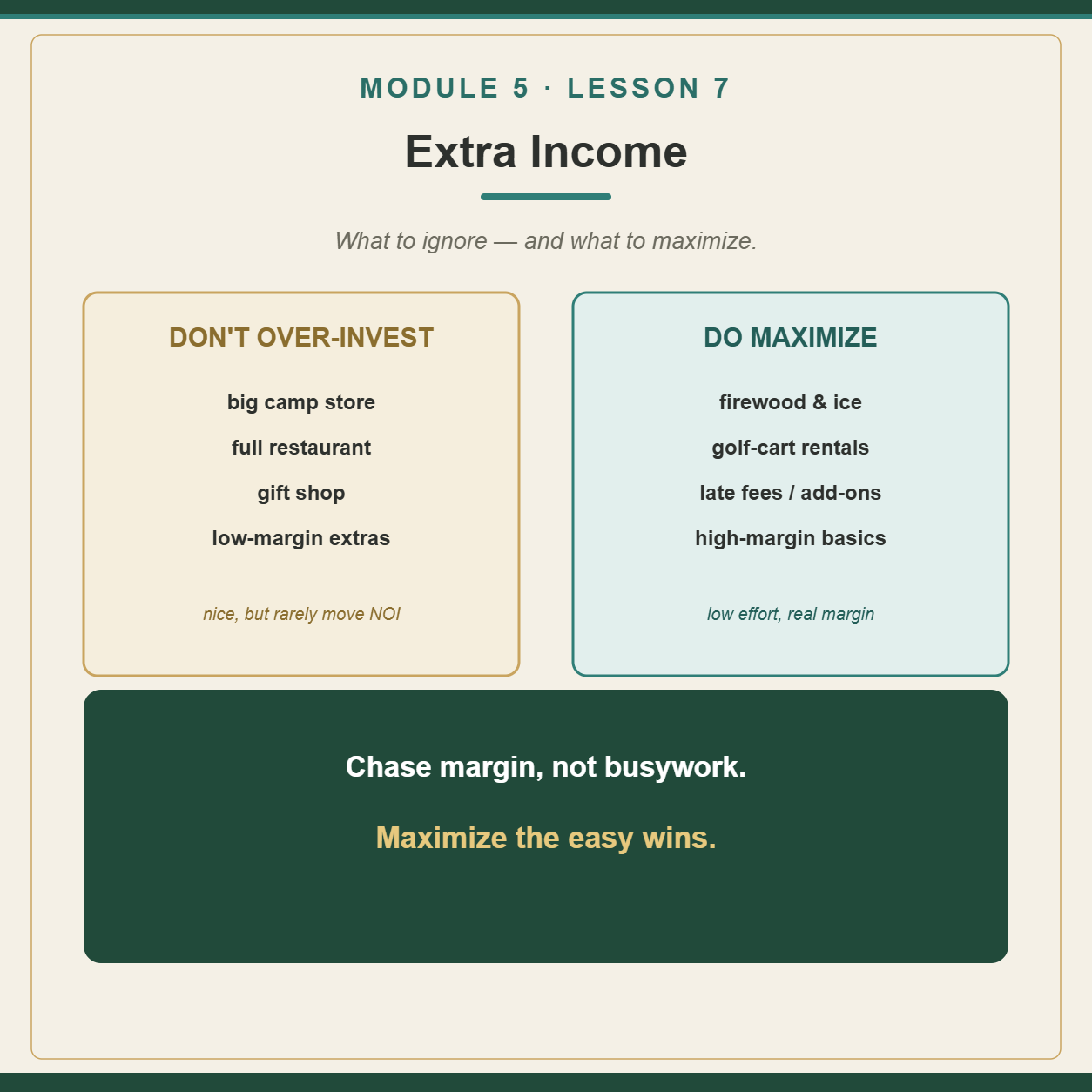
Buyers love talking about the camp store, firewood, ice, beer and wine, the gift shop, a little restaurant, activity revenue. Here’s the truth in two parts: most of these won’t make or break a deal — but a few smart, high-margin plays genuinely will. The skill is knowing which is which.
As a Buyer: Don’t Overvalue the Extras
The store, firewood, ice, vending — these are conveniences, not the reason you buy a campground. They help, but they rarely move NOI unless you’re running a large park, and they often carry thin margins (remember Harold’s propane: $50,000 in sales, $5,000 in profit). When you’re buying:
- Don’t pay a premium for fluffy extras.
- Verify each is actually profitable, not just high-revenue.
- Make sure it’s transferable — a store that thrives on the current owner’s personality may not survive the sale.
As an Owner: The Extras That Actually Pay
The real money in “extras” isn’t a vending machine — it’s charging for convenience and demand. These are near-pure margin:
- Dynamic pricing. Flex your rates with demand — higher on holidays, peak weekends, and sold-out nights; lower midweek and shoulder season to fill gaps. Software handles it automatically based on occupancy, day of week, local events, even weather. Parks that use it earn roughly 20–30% more revenue than flat-rate parks — on the exact same sites.
- Guaranteed-site upcharge. Campers will pay extra to lock in a specific site — the one on the water, the big pull-through. A site-lock fee is almost pure profit.
- Express / early check-in. A small premium for early arrival or express check-in. Convenience sells.
- A few premium services. Golf-cart rental, firewood delivery, late checkout — priced as convenience, not commodities.
The Real Multiplier: Be Different
The biggest “extra income” of all isn’t something you sell — it’s being a park people choose on purpose. At a trade show, every park looks the same. Don’t be a commodity. Go for quality over quantity. Sell what people come to see — lean into your unique draw, whether that’s the lake, the views, a theme, an event, or an experience. A park people travel for can charge more for everything.
“Buyers get starry-eyed over a camp store doing big numbers, then learn there’s no profit in it. The real extra money is in charging for what people actually want — a guaranteed site, an early check-in, a sold-out holiday weekend. And the biggest one? Be different. At a trade show, every park looks the same. The ones that win are the parks people drive past three others to reach. Sell what they come to see, and do it better than anybody.”
Lesson Takeaway
As a buyer, don’t overpay for extras that look bigger than they are. As an owner, the extras that matter charge for convenience and demand — and the biggest multiplier of all is being a park people choose on purpose. That’s usually where your next $50,000 hides, not in a new vending machine.
“The best extra income isn’t a product on a shelf — it’s being the park people come for.”