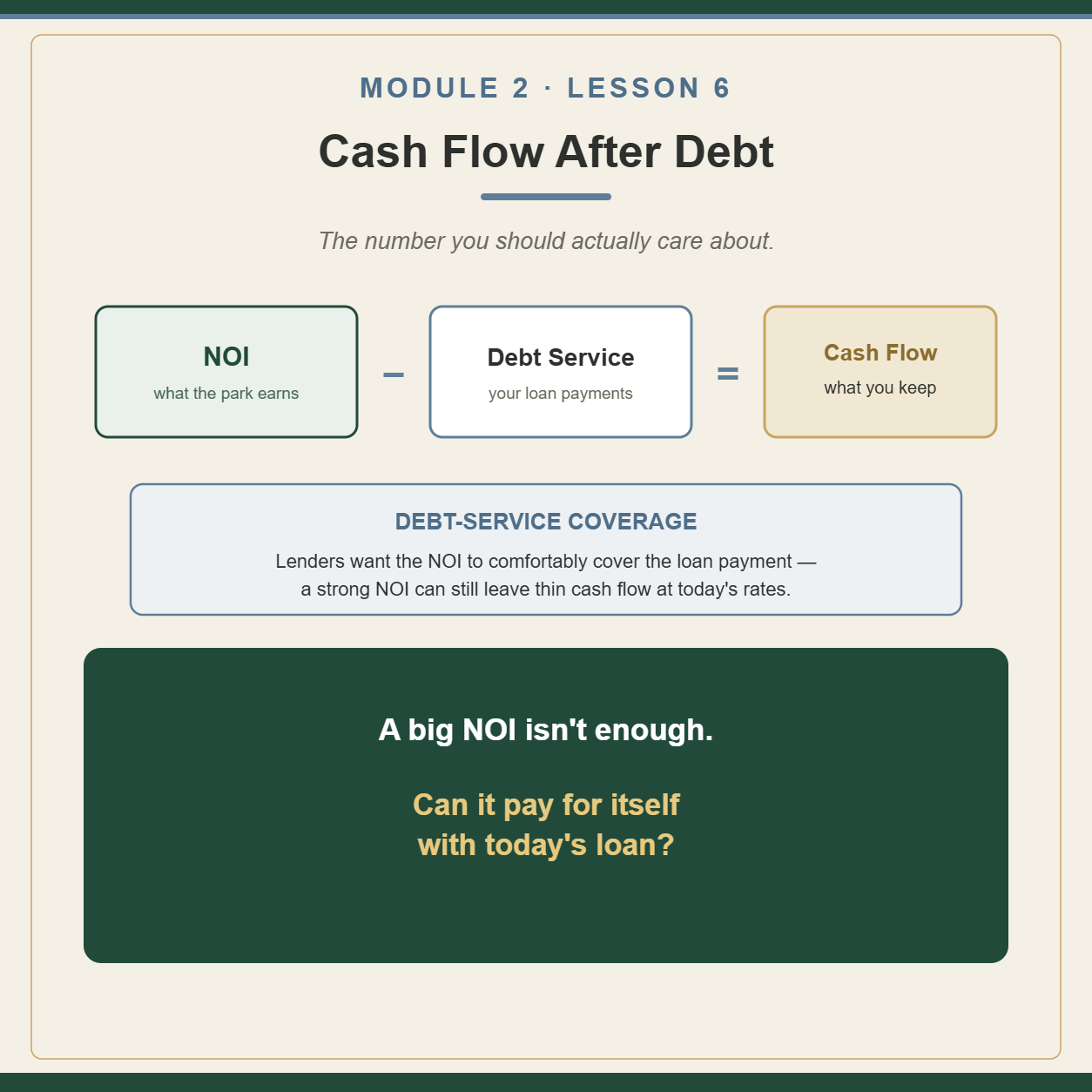
Even if a park has a strong NOI, buyers still must answer one critical question:
Can this park pay for itself with today’s loan terms?
Can this campground realistically support its debt and still operate successfully?
This is one of the biggest financial realities buyers overlook.
A campground may appear profitable on paper, but once:
- loan payments
- operational costs
- maintenance
- staffing
- reserves
- and owner income
…are all considered, the remaining cash flow may look very different.
Understanding Debt Service & Financial Obligations
Debt service generally refers to the financial obligations required to operate and finance the business.
This may include:
- campground loan payments
- principal and interest payments
- equipment loans
- vehicle loans
- lines of credit
- operational debt
- and other recurring financial obligations
The key question becomes:
After paying all operational and financing obligations, how much realistic cash flow is actually left?
Because strong campground ownership requires more than simply making the loan payment.
The business must also maintain enough remaining cash flow to:
- operate properly
- handle emergencies
- reinvest into the property
- and support long-term sustainability.
If a park cannot cover its debt with buffer, it is mostly likely not bankable.
Important Financing Concepts
Most banks and lenders focus heavily on:
DSCR (Debt Service Coverage Ratio)
DSCR is one of the primary measurements lenders use to determine:
“Can this campground comfortably afford the loan payment?”
The formula is simple:
DSCR = Net Operating Income ÷ Annual Debt Payments
In simple terms:
- After operating expenses are paid, is there enough money remaining to comfortably make the loan payment with financial cushion left over?
- Most lenders typically want to see approximately:
- 1.25 DSCR or higher
Example:
- If the campground produces:
$125,000 in NOI - And the annual loan payment is:
$100,000 - The DSCR would be:
1.25
This means the campground produces approximately 25% more income than what is needed to pay the loan each year.
That extra cash flow acts as financial cushion.
Lenders want to see enough remaining cash flow to help protect against:
- slower tourism seasons
- weather impacts
- emergency repairs
- rising expenses
- economic downturns
- and operational surprises
Campgrounds that operate too close to the financial edge are viewed as higher risk by lenders.
Strong campground financing requires more than simply covering the payment — lenders want to see operational stability and financial breathing room.
Why DSCR Matters
Many first-time buyers hear “DSCR” and think it is simply a banking term.
In reality, DSCR matters because it helps measure:
how financially stable the campground may be after debt is added to the business.
The lender is asking:
“If business slows down, repairs happen, or expenses increase… can this campground still survive financially?”
Campgrounds are seasonal and operational businesses.
Revenue can fluctuate due to:
- weather
- tourism trends
- fuel prices
- economic conditions
- staffing issues
- or unexpected repairs
If a campground operates with little financial cushion after debt service, even one difficult season can create financial stress quickly.
This is why lenders want to see:
- breathing room
- reserve cash flow
- and operational stability
DSCR is not just about loan approval.
It is also a reality check for buyers.
A campground may technically qualify for financing while still creating financial strain for the owner long term.
SBA Financing Considerations
SBA loans often have:
- strict cash-flow requirements
- detailed underwriting
- personal financial reviews
- reserve requirements
- and operational eligibility standards
The stronger the cash flow, the stronger the financing position.
SBA lenders typically want to see:
- stable historical financials
- realistic debt coverage
- operational consistency
- and enough remaining cash flow after debt service to support the business long term
Buyers should also understand that many SBA lenders prefer campgrounds to operate primarily as transient or short-term hospitality businesses rather than long-term residential style operations.
In many situations, lenders may become cautious if a campground has a high percentage of full-time or permanent residents.
A commonly discussed guideline within the industry is:
More than approximately 50% full-time occupancy may create additional SBA financing challenges depending on the lender and overall business structure.
Why?
Because heavily full-time occupied parks can begin operating more like:
- mobile home parks
- long-term housing
- or residential rental operations
…rather than traditional campground or outdoor hospitality businesses.
Lenders often evaluate these business models differently because:
- occupancy structures differ
- guest turnover differs
- operational risk differs
- and financing classifications may differ
Campgrounds focused primarily on transient RV travel, tourism, and short-term stays are often viewed more favorably within traditional campground lending models.
Financing requirements can vary by:
- lender
- occupancy structure
- business model
- regional lending appetite
- and overall campground operations
Buyers should always verify financing eligibility directly with qualified lenders early in the process.
Seller Financing
Seller financing may provide:
- more flexibility
- lower down payments
- creative deal structures
- or financing opportunities when traditional lending becomes difficult
Seller financing is never guaranteed.
Terms still must realistically work for:
- both buyer and seller
Many campground sellers still want substantial down payments, often around:
- 20–30% or more
Every seller situation is different.
Some sellers may prioritize:
- monthly income
- retirement stability
- tax planning
- faster cash-out
- lower risk
- or long-term passive income
One major factor buyers often overlook is:
the seller may already have existing debt on the campground.
In many situations, the seller may need enough down payment proceeds to:
- pay off existing loans
- satisfy lender requirements
- clear liens
- or release collateral tied to the property
This can significantly impact the amount of down payment required.
A buyer may want lower money down, but the seller’s existing loan balance may require a larger upfront payment simply to make the transaction possible.
At the same time, many sellers also need funds for:
- retirement
- purchasing a home
- relocating
- future investments
- or funding the next chapter of their lives
This is why seller financing structures can vary dramatically from one transaction to another.
Successful seller financing deals require balancing:
- buyer affordability
- seller security
- existing debt obligations
- operational cash flow
- and long-term financial goals for both parties
Every transaction has variables that must be carefully considered and structured realistically.
Your Personal Financial Position Matters
Many first-time buyers focus only on the campground itself.
However, lenders often also evaluate:
- personal income
- liquidity
- reserve funds
- outside debt
- management experience
- and working capital availability
Buying the campground is only part of the equation.
Operating it successfully is the bigger challenge.
Example:
Campground Adjusted NOI: $150,000
Annual Loan Payment: $120,000
Remaining Cash Flow After Debt Service: $30,000
At first glance, the deal may appear workable.
But buyers must then ask:
Is $30,000 enough remaining cash flow to realistically support:
- owner income
- reserve funds
- future improvements
- unexpected emergencies
- capital expenditures
- working capital
- and long-term business stability?
In many cases:
✔ the answer is no.
A campground may technically cover its loan payment while still struggling financially due to lack of operational cushion and reserve capital.
Many campground owners do push a large amount of personal expenses through the business over time, which can help reduce personal living costs.
But realistically:
If only $30,000 remains after debt service and obligations, many buyers may still need:
- outside income
- a second source of household income
- or even a part-time job
…while trying to operate the campground successfully.
Strong buyers focus not only on:
whether the business can survive debt service today
…but whether the business can remain healthy, sustainable, and financially stable long term.
Different Buyers Create Different Expense Structures
One of the biggest things buyers must understand is that different ownership structures can dramatically change operating costs.
Many owner-operated campgrounds function with:
- lower payroll
- direct owner involvement
- family labor
- lean management structures
- and tighter operational control
However, investor or group-operated campgrounds often introduce additional expenses such as:
- management company fees
- executive compensation
- investor distributions
- additional payroll
- corporate overhead
- and outside operational staffing
In some situations, these added expenses can increase operational costs significantly.
For example:
A campground currently operating at a 40% expense ratio under owner management may look very different under a larger investor structure operating closer to 60–70% expenses.
This can dramatically impact:
- cash flow after debt
- financing ability
- future growth potential
- reserve funds
- and long-term sustainability
This is one reason buyers cannot rely on spreadsheets alone.
The operational structure behind the numbers matters.
Cash Flow Must Support More Than Just the Loan
A campground must do more than simply “make the payment.”
Strong campground operations also need cash flow available for:
- maintenance
- emergencies
- future upgrades
- working capital
- staffing
- reserve funds
- and owner income
If all available cash flow is consumed by debt and operational overhead, the business may struggle long-term even if the loan technically gets paid.
Healthy campground operations require financial cushion.
What Buyers Must Understand
If a campground cannot realistically:
- support its debt
- maintain operations
- build reserves
- and provide operational cushion
…it may not be financially sustainable long term.
Strong campground buyers focus on:
- survivability
- operational flexibility
- and long-term sustainability
—not just whether the loan can technically be approved.
LESSON TAKEAWAY
Cash flow after debt service is one of the most important numbers in campground ownership.
The goal is not simply:
“Can I buy the campground?”
The real question is:
“Can this business realistically support debt, operations, future growth, and long-term stability?”
Strong buyers learn to evaluate:
- cash flow
- debt obligations
- operational structure
- reserves
- and long-term sustainability
before making a purchase decision.
“A campground should do more than cover debt — it should provide stability, flexibility, and room to grow.”